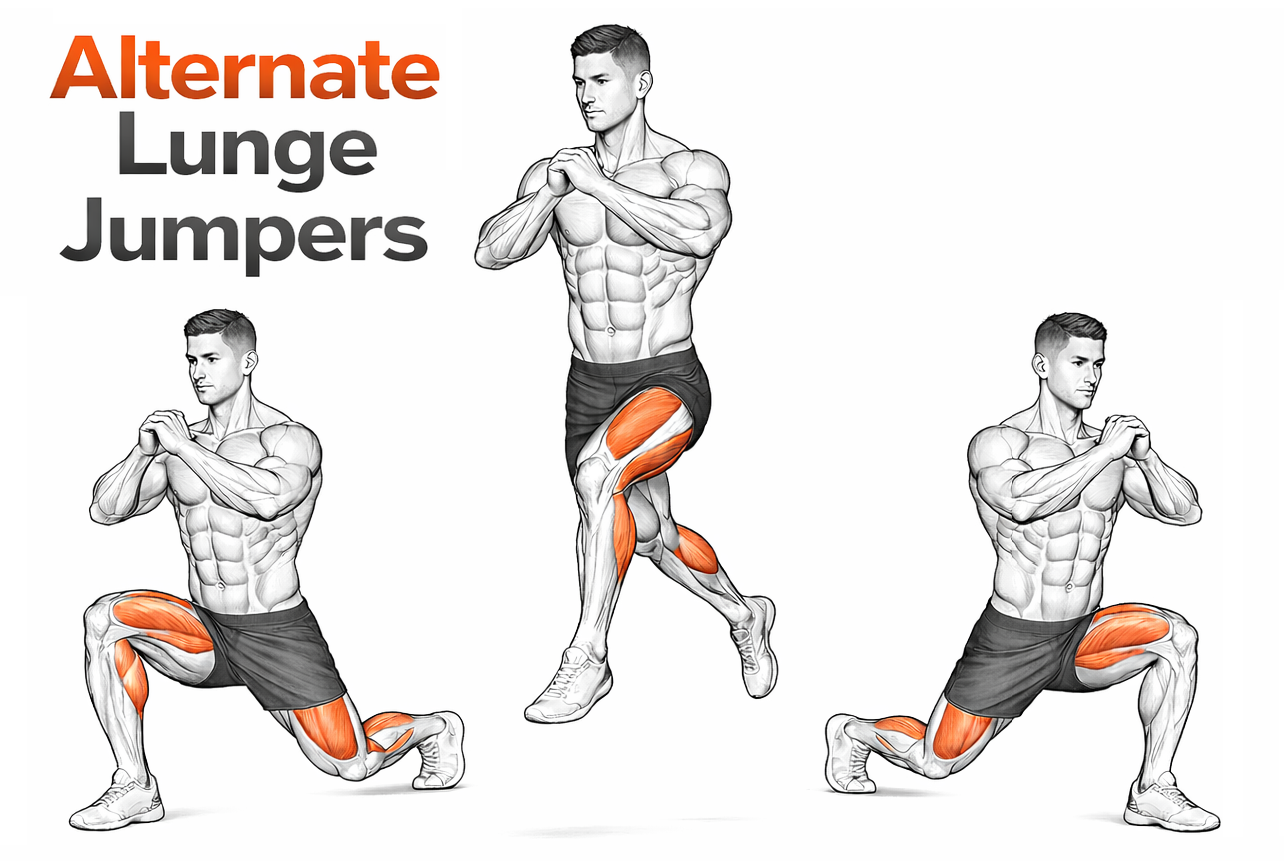
Alternate Lunge Jumpers
Explosive jumping lunge with mid-air leg switch — a conditioning staple that hammers the quads and glutes while spiking the heart rate.
Level: Intermediate
Primary: Cardio
Secondary: Glutes Quads
Movement: Compound
Tags: Explosive Lunge Unilateral
Type: Anaerobic Intervals (HIIT / Bootcamp / Circuit) Plyometric
Equipment: Body Weight
Sports: Basketball Football Lacrosse Soccer Tennis Volleyball
Target muscles
The quadriceps and gluteus maximus do the bulk of the work on each landing and the subsequent jump. Hamstrings and calves contribute to the takeoff. The trunk muscles — obliques, spinal erectors, transverse abdominis — fight to keep the torso vertical through every switch, which is why your abs ache the day after even though you didn't think of this as ab work. Cardio-wise, this is a high-intensity interval movement, with heart rate climbing fast because you're moving large muscles under load.
How to perform
Setup
Drop into a split-stance lunge, front shin roughly vertical, back knee a few inches off the floor. Hands can stay relaxed at your sides or come up in a runner's-arm pose for rhythm — pick one and stick with it. Torso stays tall, ribs over hips, eyes forward. Take a breath in.
Execution
Push hard through both feet — front foot driving more than the back — and explode straight up. Switch leg positions in the air so the back leg comes forward and the front leg goes back. Land softly with both knees bending immediately to absorb impact, ending in a mirror-image lunge. Pause just long enough to feel the floor, then jump again. Quiet landings matter more than max height; if you sound like a herd of cattle, you're not absorbing properly. Breathe rhythmically — exhale on the jump, inhale during the brief landing.
Common mistakes
- Letting the front knee crash inward on landing. Drive it out over the second toe and load the glute.
- Front knee shooting way past the toes on landing — usually means the trailing leg isn't doing its share of the absorption.
- Torso pitching forward to chase the jump. Stay tall; the height comes from your legs, not your spine.
- Landing on flat feet or, worse, the heels. You should land mid-foot and roll back to flat.
- Cutting the lunge depth shorter and shorter as fatigue builds. Hit honest depth or stop the set.
Progressions and regressions
Regress to alternating reverse lunges (no jump) until you can manage twenty unbroken reps with clean form. Then move to bodyweight split-squat jumps without switching legs — same height, half the coordination demand. Once those feel easy, add the leg switch. To progress, hold a pair of light dumbbells at the sides (5-10 lb to start), or chase faster cycle rates against a clock — twenty reps for time, then beat that number. Box-jump variants make a natural follow-on for plyometric power.
Programming notes
This is conditioning, not strength. Use it in HIIT blocks (30 seconds on / 30 seconds off for 6-10 rounds), as a finisher (one or two all-out sets of 30-60 seconds), or as part of a circuit between heavier lifts. Don't program it the day before a heavy squat session — the eccentric load on the quads adds up fast and bleeds into your barbell work. Beginners should cap the first few sessions at 20 total reps and add five per week as the connective tissue adapts.