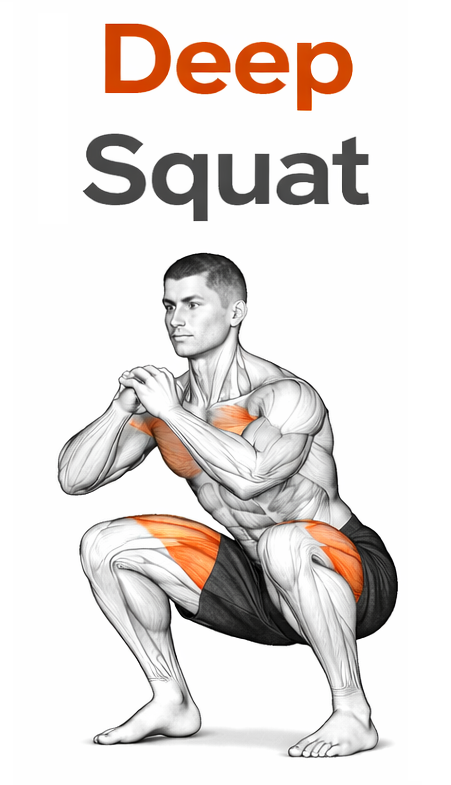
Deep Squat
Static deep-squat hold or controlled deep-squat reps — fundamental hip mobility position that every lifter should own.
Level: Beginner
Primary: Cardio Quads
Secondary: Glutes Hamstrings
Movement: Isolation
Tags: Squat
Type: ISO Light Activity Primal Movments (Animal Flow-QMT Specifics)
Equipment: Body Weight
Sports: Basketball Football Rugby Track and Field Volleyball
Target muscles
The quadriceps hold deep knee flexion under bodyweight; the gluteus maximus and hamstrings hold hip extension at the bottom of the deep squat. The adductors are loaded through their full range — and a tight adductor is what limits depth for most lifters. The ankles work through their dorsiflexion range. The trunk and spinal erectors hold the upright torso. As a movement, this is more about mobility and joint awareness than strength — but the mobility carries over directly to every loaded squat that follows.
How to perform
Setup
Stand with feet shoulder-width apart, toes slightly turned out 15-30 degrees. Arms ready to extend forward for balance. Take a breath.
Execution
Squat as low as possible — ideally with the hip crease well below the top of the knee, the chest as upright as flexibility allows, heels staying flat on the floor. The arms can hold a counterbalance position in front, the elbows can press the knees out gently, or the hands can come together at the chest in a prayer position. Hold at the bottom for the prescribed time, or move slowly through deep squat reps. The position should be relaxed at the bottom — if you're working hard to hold it, your mobility needs more development.
Common mistakes
- Heels lifting off the floor. If you can't keep them down, work on ankle mobility before chasing depth — wear shoes with a small heel raise temporarily, but the goal is barefoot or flat-soled.
- Lower back rounding hard. A slight curl is fine at deep range; a hard round suggests adductor tightness limiting hip flexion.
- Knees collapsing inward. Drive them out actively over the second toes.
- Forcing depth that the body isn't ready for. Stop where the position is honest; build the range over weeks.
- Skipping the hold time. The mobility benefit comes from sustained positions, not just touching depth and bouncing back up.
Progressions and regressions
Regress with a supported deep squat — hold a sturdy pole or rack with the hands while squatting down, letting the support take some of the work. Sit on a low box if needed. To progress, hold the deep squat for 90 seconds at a time, then load it (light goblet weight, then heavier), or work toward the pistol squat as a single-leg deep-squat progression.
Programming notes
Essential mobility work. Two or three 90-second holds daily for anyone with desk-job hip tightness. As a warm-up before squat sessions, one 60-second hold primes the joints. Most lifters benefit from the deep-squat hold more than from any single mobility drill — and the carryover to squat depth and squat strength is direct. Pair with daily ankle mobility work for maximum effect.