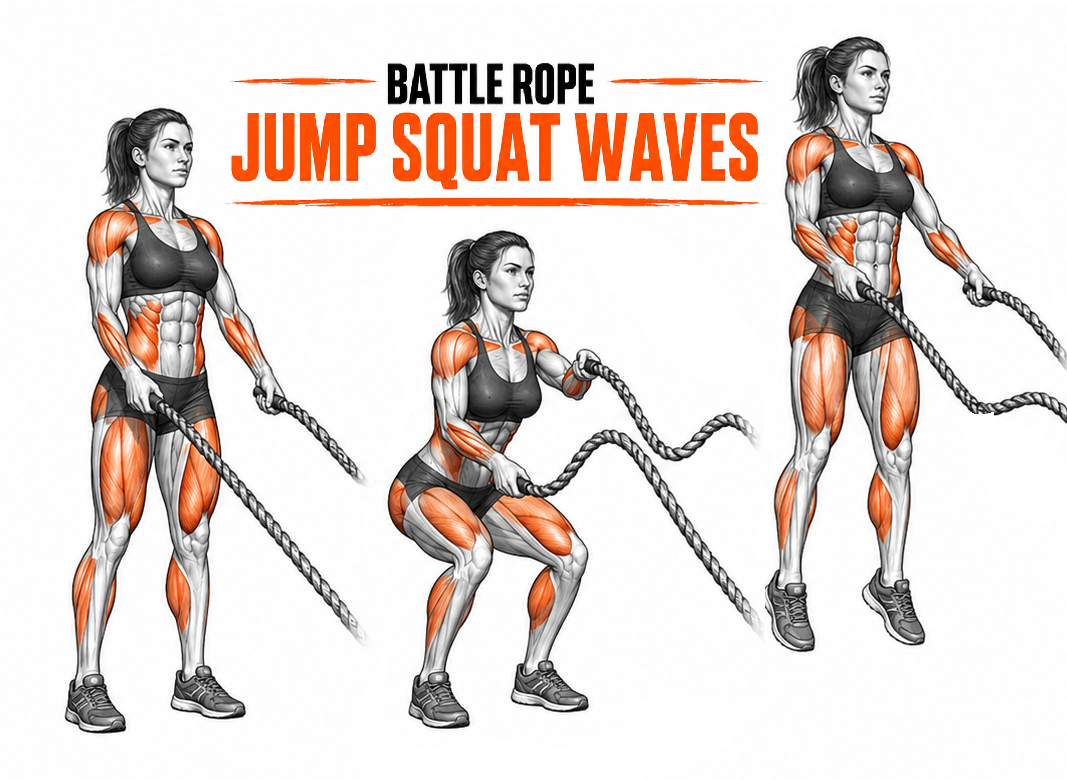
Battle Ropes Jump Squat Waves
A relentless cardio drill pairing continuous rope waves with repeated jump squats so the legs, lungs and shoulders all burn at once.
Level: Intermediate
Primary: Cardio
Secondary: Glutes Quads Shoulder
Movement: Compound
Tags: Explosive Squat
Type: Anaerobic Intervals (HIIT / Bootcamp / Circuit) Plyometric
Equipment: Battle Ropes
Target muscles
Conditioning leads the way: combining lower-body plyometrics with non-stop arm work makes this one of the most cardio-demanding rope drills there is. The quads and glutes drive the repeated jump squats, the calves contribute to each takeoff and landing, and the shoulders and forearms keep the waves alive the whole time. The core braces to keep the trunk stable as the legs jump and the arms pump, tying the whole effort together.
How to perform
Setup
Take a rope end in each hand and stand facing the anchor with light tension on the line. Set a shoulder-width stance, sit the hips back into a quarter- to half-squat, and brace the core with the chest tall. Keep the shoulders set down, your weight through the midfoot and the knees tracking over the toes, and begin driving the waves before you start adding the jumps so the rhythm is established.
Execution
Keep alternating or double waves going continuously while you repeatedly jump-squat — sinking into a squat, then exploding up off the floor, and landing soft to immediately sink into the next. Maintain the wave rhythm with the arms even as the legs jump, which is the real challenge. Land through soft knees with the hips back, and keep the chest up rather than collapsing forward. The arms and legs work on their own cadences, so settle into a pace where both can hold up for the full interval.
Common mistakes
- Letting the rope waves die the moment the jumps begin instead of keeping both going at once.
- Landing hard and flat-footed rather than absorbing through the knees and hips.
- Caving the knees inward on the jump or the landing.
- Starting at a sprint pace and gassing out before the interval ends.
Progressions and regressions
Regress by replacing the jump squats with bodyweight squats or squat pulses while keeping the waves going, or by shortening the interval until the coordination settles. Progress by jumping higher, lengthening the work bout, or switching the waves to harder double slams between jumps. A single-leg or split-jump variation raises the difficulty sharply, and widening the squat stance shifts more of the load onto the glutes and adductors while keeping the conditioning cost high.
Programming notes
Use it as hard interval conditioning, 4-8 rounds of 20-30 seconds of work against 30-60 seconds rest. It drives the heart rate up quickly, so it belongs in a HIIT or finisher slot rather than early when you need fresh legs. Keep landings clean and ease off if the knees or ankles are sensitive, since the jumping volume adds up fast.