Full Back Lever
The upper back and stretched chest suspend a completely straight body face-down and horizontal, arms behind, in one of gymnastics' hardest static holds.
Want a bodyweight back workout?
Our wizard builds one around your time, goal, and equipment in about two minutes. Free — no signup needed.
Make Me a Workout → Just did it? Track your sets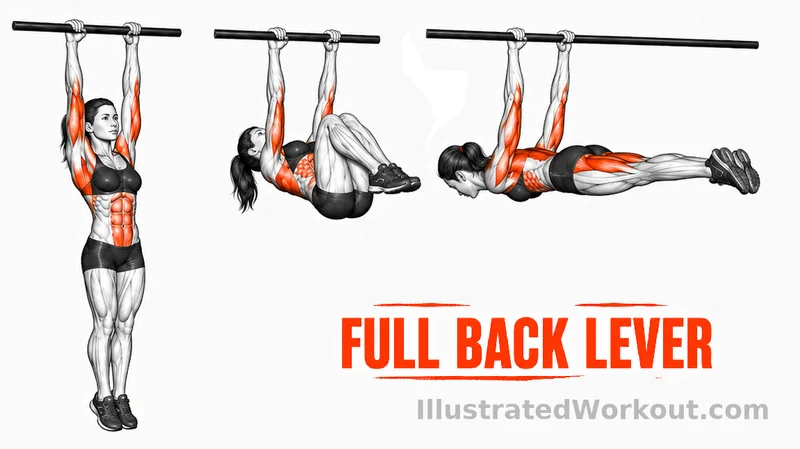
The upper back and stretched chest suspend a completely straight body face-down and horizontal, arms behind, in one of gymnastics' hardest static holds.
Level: Elite
Primary: Back - Upper Chest
Secondary: Abs Biceps Forearms Shoulder
Movement: Compound
Tags: Core Stability
Type: ISO
Equipment: Body Weight
Target muscles
With the legs squeezed together and the body fully straight, the lever reaches its longest point, and the lats and teres major generate maximal torque to hold the torso horizontal and face-down. The pectorals, anterior deltoids and long head of the biceps endure a severe stretch load holding the straight arms behind the body, which is why the position is so demanding on the elbows and shoulders. The abdominals and glutes lock a flat line, and the forearm flexors grip hard throughout.
How to perform
Setup
Pull to an inverted hang with straight arms and a shoulder-width grip. Squeeze the legs together, point the toes and set the shoulders down with the blades gathered. Brace the abs and glutes to build a single rigid line before lowering.
Execution
Lower the straight, joined-leg body backward under full control until the torso reaches horizontal, face-down. Keep the arms locked and resist the intense stretch dragging through the biceps and chest. Drive the shoulders down and away from the bar and hold the body dead level from collarbone to toes. Keep the abs braced and glutes squeezed so the lower back neither arches nor the hips sag. Breathe in short, controlled sips and end the hold the instant the arms begin to bend or the line drops.
Common mistakes
- Piking the hips upward to shorten the lever, which turns a full back lever into an easier tucked or open version.
- Over-arching the lumbar spine so the abs release and the stretch dumps onto the shoulders and biceps unsafely.
- Dropping into the position too fast rather than lowering slowly, which spikes strain on the biceps tendon.
- Letting the elbows unlock as the anterior chain fatigues, collapsing the straight-arm structure.
Progressions and regressions
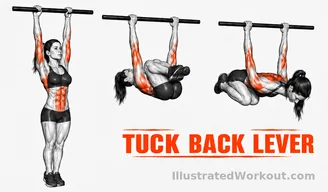
Regress to the advanced open or straddle back lever, where the shorter lever keeps the shoulder and biceps load manageable. Build tissue resilience first with German hangs, skin-the-cats and straight-arm pulldowns. Progress by extending hold time, moving from a pronated to a supinated grip for a harder biceps position, or transferring the hold from bar to rings.
Programming notes
This is an elite hold: train it fresh, early in a session, with the shoulders and elbows fully warm. Accumulate total time across several five to ten second holds rather than one maximal grind, and progress the volume slowly. Two or three sessions a week is plenty. Do not program it if the front of the elbow or shoulder is irritated, and never chase it before you own the straddle, since the straight-arm stretch punishes unprepared tendons.