Push-Up Shoulder Taps
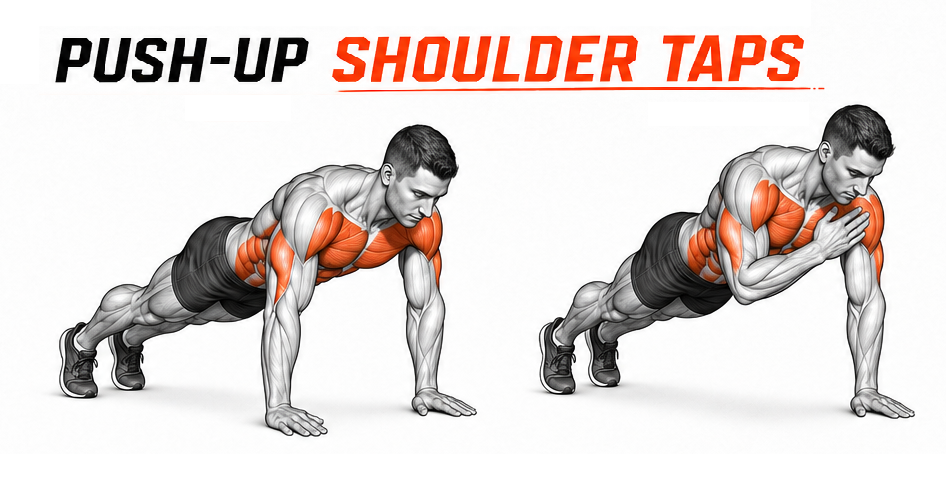
A push-up that adds an opposite-shoulder tap at the top of each rep, forcing the core to resist rotation while pressing on a single arm.
Level: Intermediate
Primary: Chest
Secondary: Abs Shoulder Triceps
Movement: Compound
Tags: Anti-Rotation Push
Type: Functional Fitness (Obstacle & Hybrid) Strength (Weight Lifting)
Equipment: Body Weight
Target muscles
The pectoralis major, anterior deltoids and triceps drive the push-up, but the shoulder tap turns it into a fierce anti-rotation exercise: lifting one hand to tap the opposite shoulder leaves the body briefly supported on one arm, and the obliques and rectus abdominis must fight hard to stop the hips from twisting toward the floor. The supporting shoulder and serratus stabilise the single-arm load, and the glutes stay tight to hold the line.
How to perform
Setup
Begin in a high plank with the hands under the shoulders and the feet set about hip-width or slightly wider, which gives a more stable base for the single-arm support. Brace the abs, squeeze the glutes, and set the hips level.
Execution
Perform a controlled push-up, lowering the chest with the elbows tucked and pressing back to the top. At the top, shift the weight subtly to one hand and lift the other to tap the opposite shoulder, keeping the hips dead level so the pelvis does not rotate. Return the hand and repeat the push-up, alternating which shoulder you tap. The whole challenge is keeping the torso square during the tap — the wider the feet, the easier that is. Move deliberately, taking the tap slowly so the core controls the rotation rather than rushing through it.
Common mistakes
- Letting the hips rotate and dip toward the floor during the shoulder tap instead of holding them square.
- Setting the feet too narrow, which makes the single-arm support unstable and forces the hips to twist.
- Rushing the tap so it becomes a quick swipe rather than a controlled, braced movement.
- Letting the push-up form degrade — flaring elbows or sagging hips — as attention shifts to the taps.
Progressions and regressions
Regress by separating the two skills: do shoulder taps in a static plank without the push-up, or push-ups from the knees, until the core control is solid. Progress by narrowing the feet, adding a tempo to the push-up, or moving to a feet-elevated position. Tapping the opposite knee or adding a knee drive layers in more demand once the basic version is controlled.
Programming notes
Program it as a core-integrated pressing movement, three sets of six to ten reps per side or per push-up. It builds pressing strength and anti-rotation control at once, which suits functional circuits and athletic conditioning. Keep the hips level and the taps controlled; if the pelvis is twisting, widen the stance or regress, because the anti-rotation work is the reason to do it.