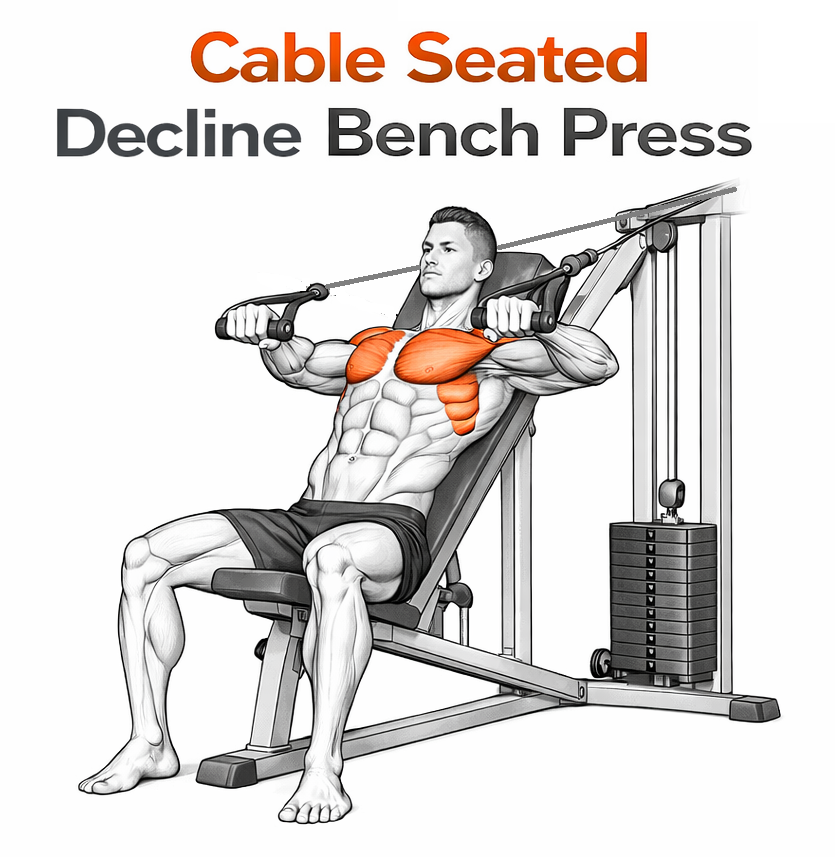
Cable Seated Decline Bench Press
Cable bench press from a slight decline angle — biases the lower chest with constant tension through a downward-pressing arc.
Level: Foundation
Primary: Chest
Secondary: Shoulder Triceps
Movement: Compound
Tags: Push
Type: Strength (Weight Lifting)
Equipment: Cable
Sports: Football Rugby
Target muscles
The lower (sternocostal) head of the pectoralis major takes the largest share of the work thanks to the decline angle and the downward press arc. The anterior deltoid contributes through shoulder flexion. The triceps brachii lock out the elbows. The serratus anterior stabilizes the scapulae. The decline angle puts the shoulder in a more shoulder-friendly position than the flat bench for many lifters — the deltoid loading drops while the chest loading rises.
How to perform
Setup
Position a slight-decline bench (15-30 degrees) between two cable stacks with the cables set at upper-chest height. Sit on the bench with the back firmly against the pad. Grip the handles, pull them to upper-chest height with elbows tucked. Plant the feet under the leg supports if available; otherwise just on the floor. Trunk braced.
Execution
Press the handles forward and slightly downward — the arc travels at the same angle as the bench's incline. Bring the handles together at the contracted position. Squeeze the lower chest. Lower the handles back to the start under control. The decline angle means the press finishes lower than chest height; that's the angle that biases the lower-pec fibers.
Common mistakes
- Using a too-steep decline. 15-30 degrees is the working range; deeper declines lose the bench-press carryover and put more strain on the head-down position.
- Flaring the elbows. Tuck them at about 45 degrees.
- Not bringing the hands together. The cable convergence at the top loads the chest where dumbbells can't.
- Letting the back come off the pad as fatigue builds. Stay pressed against the bench.
- Loading the cable too heavy for a clean range. Chest cables typically load lighter than dumbbells or barbells at similar feel.
Progressions and regressions
Regress to dips (chest-emphasis dips — torso leaned forward, elbows tucked) for similar lower-chest loading from a bodyweight position. Decline dumbbell bench provides a more standard variant. To progress, work pause reps (2-second pause at the chest), single-arm decline cable presses, or decline cable flyes for chest isolation.
Programming notes
Useful secondary chest movement on a chest-focused day. 3-4 sets of 8-12 reps. Once a week. The decline angle is gentler on the shoulders than a flat bench for most lifters; programs that aggravate the front delts often benefit from substituting decline cables for flat work for 4-8 week blocks. Pair with incline pressing variations to hit both chest heads.