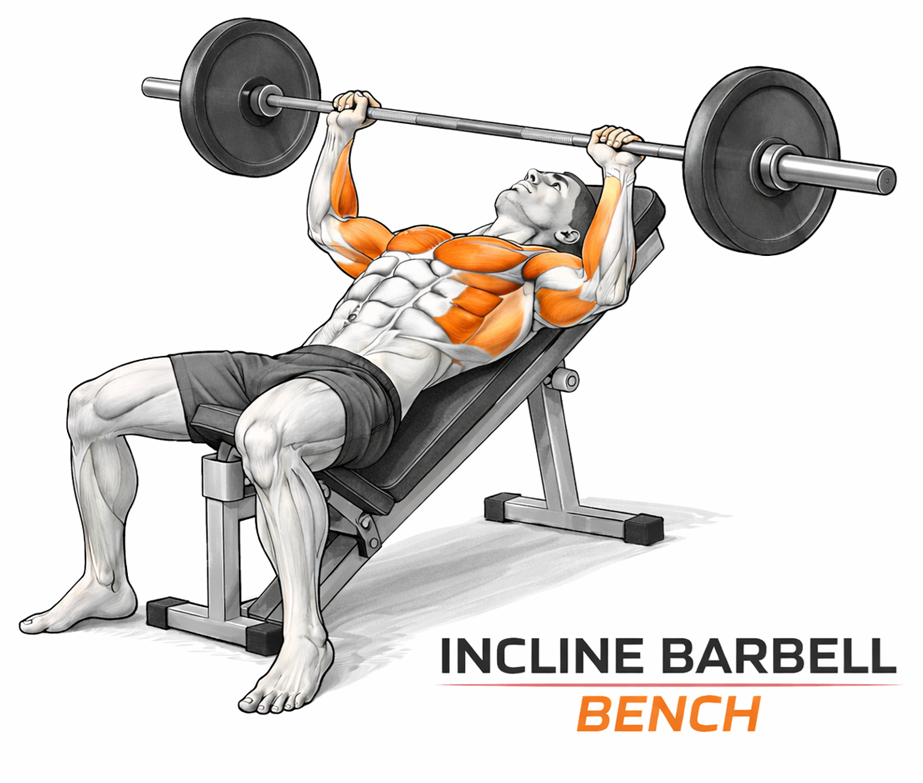
Barbell Incline Bench
Incline barbell bench press at 30-45 degrees — shifts the chest emphasis to the upper pec while increasing the deltoid contribution.
Level: Foundation
Primary: Chest
Secondary: Shoulder Triceps
Movement: Compound
Tags: Push
Type: Strength (Weight Lifting)
Equipment: Barbell
Sports: Football Rugby Track and Field
Target muscles
The clavicular (upper) head of the pectoralis major is the main beneficiary of the incline angle. The anterior deltoid contributes more than in a flat bench because the press now travels at an angle closer to shoulder flexion. The triceps brachii lock out the elbows. The serratus anterior and the upper back work to keep the scapulae stable through the press. The steeper the incline, the more the work shifts from the chest to the front delts; somewhere between 30 and 45 degrees is the sweet spot for upper-pec emphasis without overloading the shoulders.
How to perform
Setup
Set an adjustable bench between 30 and 45 degrees — closer to 30 keeps more pec involvement, closer to 45 shifts more to the delts. Lie back, eyes under the bar, feet flat on the floor. Pull the shoulder blades back and down against the bench; chest stays proud, not collapsed. Grip the bar slightly wider than shoulder-width. Big breath, brace, unrack.
Execution
Lower the bar to the upper chest — between the collarbone and the nipple line, depending on bench angle and your anatomy — with the elbows tucked at about 45 degrees from the torso. Touch the chest, briefly. Press back up and slightly back toward the rack, finishing with locked elbows over the shoulders. Don't bounce the bar off the chest. Keep the feet driving into the floor through the entire set; if the lower body goes limp, you'll lose stability and strength on the press.
Common mistakes
- Setting the bench too steep (60+ degrees), which turns the lift into a partial overhead press. Keep it between 30 and 45.
- Flaring the elbows out wide. Tuck them at about 45 degrees to protect the shoulders.
- Hips coming off the bench on heavy sets. Hips down, feet planted, or the load is too heavy.
- Pressing the bar straight up rather than slightly back toward the face. The bar path on incline is even more of a shallow J than on flat bench.
- Skipping the warm-up sets. The shoulders need a few light sets to get into the incline groove safely.
Progressions and regressions
Regress to incline dumbbell press (less stability demand, easier on the shoulders). For a strict beginner, start with low-incline push-ups (feet up on a low box, hands on the floor) before loading a barbell. To progress, work pause reps (2-3 seconds at the chest), reverse-grip incline bench (palms toward the face — surprisingly effective for upper-chest emphasis), or alternate incline angles week to week (30 one week, 45 the next).
Programming notes
Excellent as a primary pressing movement on an upper-body day, or as the second pressing exercise after flat bench. 3-4 sets of 6-10 reps for hypertrophy, 4-5 sets of 4-6 for strength. Two pressing sessions per week is plenty for most lifters. Pair pressing volume with rowing volume in equal or greater measure — incline emphasizes the front delts, which need rear-delt and upper-back balance to stay healthy.