Tuck Back Lever
Body tucked tight and held face-down and horizontal, the upper back and chest learn the back lever line at its most forgiving lever length.
Want a bodyweight back workout?
Our wizard builds one around your time, goal, and equipment in about two minutes. Free — no signup needed.
Make Me a Workout → Just did it? Track your sets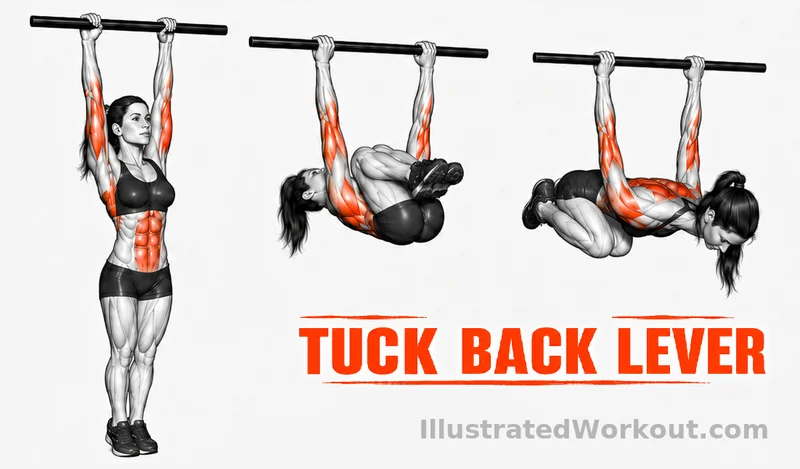
Body tucked tight and held face-down and horizontal, the upper back and chest learn the back lever line at its most forgiving lever length.
Level: Advanced
Primary: Back - Upper Chest
Secondary: Abs Biceps Forearms Shoulder
Movement: Compound
Tags: Core Stability
Type: ISO
Equipment: Body Weight
Target muscles
Curling the knees tight to the chest keeps the lever short, making this the entry point to the back lever, but the lats and teres major still work to hold the tucked torso horizontal and face-down. The chest, anterior deltoids and biceps begin to take the characteristic stretch load through the straight arms behind the body, teaching the shoulders and elbows to tolerate that position. The abdominals brace to hold the tuck level and stop the back arching, and the forearm flexors grip throughout.
How to perform
Setup
Pull to an inverted hang with straight arms and a shoulder-width grip. Curl the knees tightly to the chest and round the back slightly into a compact ball. Set the shoulders down, gather the blades and brace the abs before lowering into position.
Execution
Lower the tucked body backward under control until the torso is horizontal, face-down, keeping the knees pinned close to the chest. Hold the arms locked and drive the shoulders down and away from the bar to manage the stretch through the biceps and chest. Keep the torso level rather than letting the hips drop or rise, and hold the tuck tight so the lever stays short. Breathe in short controlled breaths and stay patient, since even this shortest version loads the anterior shoulder. End the set the instant the arms begin to bend or the line sags.
Common mistakes
- Letting the knees drift away from the chest, which unintentionally lengthens the lever and spikes the load before you are ready.
- Piking the hips high so the torso tilts rather than holding a level, horizontal tuck.
- Bending the elbows instead of keeping straight arms, which is the whole point of the drill.
- Rushing the descent into the hold rather than lowering slowly, which strains the biceps tendon.
Progressions and regressions
Regress by holding a higher, more vertical tuck for even less lever, or by building shoulder tolerance first with German hangs, skin-the-cats and straight-arm pulldowns. Progress by opening the hips into the advanced tuck back lever, then the straddle and full versions. Practising slow negatives into the tuck develops control of the descent.
Programming notes
Program it as the first true back lever, trained early in a session with the shoulders and elbows warm. Accumulate time across sets of ten to fifteen seconds rather than a single grind, and build volume gradually so the anterior tissues adapt. Two or three sessions a week suit it. It is the foundation of the back lever family, so treat the straight-arm position with respect and stop if the front of the elbow or shoulder gets sore.