Full Front Lever
Lats and rectus abdominis hold a rigid, straight body face-up and perfectly horizontal beneath the bar, the benchmark straight-body pulling hold.
Want a bodyweight core workout?
Our wizard builds one around your time, goal, and equipment in about two minutes. Free — no signup needed.
Make Me a Workout → Just did it? Track your sets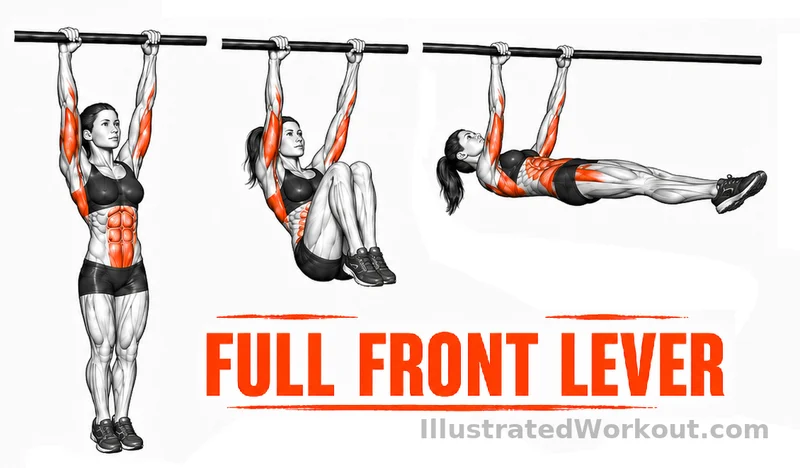
Lats and rectus abdominis hold a rigid, straight body face-up and perfectly horizontal beneath the bar, the benchmark straight-body pulling hold.
Level: Elite
Primary: Abs Back - Upper
Secondary: Biceps Forearms Shoulders - Rear
Movement: Compound
Tags: Core Stability
Type: ISO
Equipment: Body Weight
Target muscles
A fully straight, level, face-up body puts the front lever at its longest, and the lats and teres major produce maximal straight-arm pulling force to keep the torso parallel with the floor. The rectus abdominis and hip flexors brace at full intensity to resist the extension trying to fold the hips downward, which is the hold's defining anti-extension core demand. The rear deltoids and long head of the biceps stabilise the loaded straight arms, and the forearm flexors grip hard against the bar.
How to perform
Setup
Hang from a bar with a shoulder-width overhand grip and pull the shoulder blades down and together. Squeeze the legs together, point the toes and tilt the pelvis under into a firm hollow. Straighten the arms and brace the entire trunk before initiating the lift to horizontal.
Execution
Pull the straight arms down toward the hips to raise the rigid body until it is parallel with the floor, face-up, legs joined and toes pointed. Drive the bar down through the lats without bending the elbows, and keep the shoulders depressed rather than shrugging. Fight to keep the hips exactly level with the shoulders by bracing the abs and holding the posterior pelvic tilt against gravity's pull into a sag. Hold the line dead flat from grip to toes, breathe shallowly, and finish the moment the hips drop or the arms unlock.
Common mistakes
- Letting the hips sag into a sway-back because the abs fatigue before the lats, so the straight line bends at the waist.
- Bending the elbows to muscle the torso up rather than holding a true straight-arm pull from the lats.
- Losing scapular depression so the shoulders drift toward the ears and the lever load hangs off the joint.
- Splitting or bending the legs to quietly shorten the lever instead of holding the full straight body.
Progressions and regressions
Regress to the straddle front lever, where the split legs shorten the lever, or to the advanced tuck to rebuild the pull. Weighted tuck and straddle holds, plus front lever raises, develop the strength to hold the full line. Progress by extending hold time, adding rings, or performing slow front lever raises and pulls from the full position for dynamic strength.
Programming notes
Program it as an elite skill and core piece at the very start of a pull session, when the lats, core and grip are fresh and strong. Accumulate time across sets of five to ten seconds rather than one maximal hold, progressing volume gradually. Two or three exposures a week suit it. Do not attempt it before the straddle is solid, since a premature full lever usually just trains a sagging, half-piked line rather than the true skill.