Plank Jacks
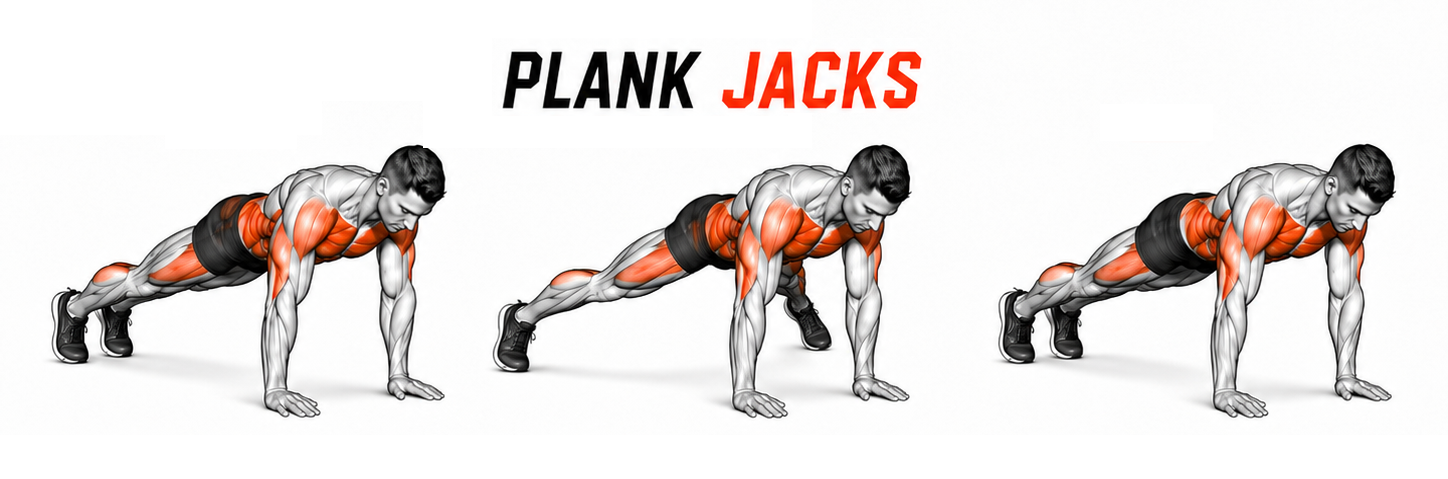
A horizontal jumping jack held in a plank, jumping the feet wide and back while the core fights to keep the hips from bouncing.
Level: Foundation
Primary: Abs
Secondary: Cardio Shoulder
Movement: Isolation
Tags: Core Stability
Type: Anaerobic Intervals (HIIT / Bootcamp / Circuit) ISO
Equipment: Body Weight
Target muscles
The rectus abdominis and transverse abdominis brace hard to keep the spine neutral while the legs jump in and out, which is the anti-extension job of the core under a moving load. The hip abductors and adductors drive the feet wide and pull them back together, the shoulders and serratus stabilise the plank, and the continuous jumping pushes the heart rate up. It blends a static core hold with a cardio stimulus.
How to perform
Setup
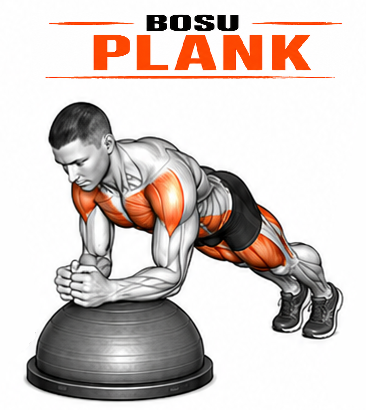
Set up in a forearm or high plank with the body in one straight line, feet together, abs braced and glutes squeezed. Make sure the hips are level and the shoulders are stacked over the elbows or wrists before you start jumping.
Execution
Keeping the plank rigid, jump both feet out wide to the sides, then jump them straight back together — like the legs of a jumping jack performed face-down. The upper body stays locked and still; only the legs travel. Keep the hips low and level so they do not pike up or sag with each jump, and absorb the landings softly on the balls of the feet. Maintain a steady rhythm and breathe throughout. The faster you go, the harder the core has to work to keep the torso from bouncing, so prioritise a quiet midsection over raw speed.
Common mistakes
- Letting the hips bounce up and down with each jump instead of holding them level.
- Piking the hips toward the ceiling as fatigue sets in to offload the core.
- Landing heavily and stiffly rather than absorbing softly on the balls of the feet.
- Letting the shoulders drift forward past the support point and losing the plank line.
Progressions and regressions
Regress by stepping the feet out and in one at a time rather than jumping, or by holding a static plank until the base is solid. Progress by increasing speed, adding a push-up between jacks, or moving to a hands-on-the-floor position for a longer lever. Combining plank jacks with shoulder taps adds an anti-rotation layer.
Programming notes
Program it as core conditioning or a circuit station, twenty to forty seconds of continuous work or sets of ten to twenty jacks. It raises the heart rate while keeping the core engaged, so it fits HIIT and bootcamp formats. Keep the hips quiet and stop when the torso starts bouncing, since a sloppy plank jack trains nothing but momentum.