Kettlebell Oblique Hip Raises
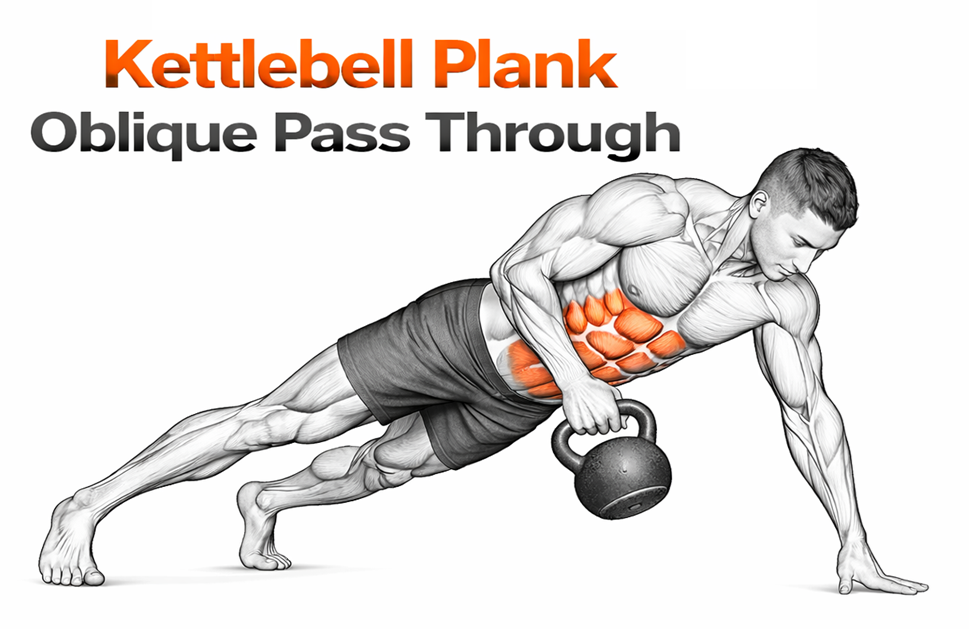
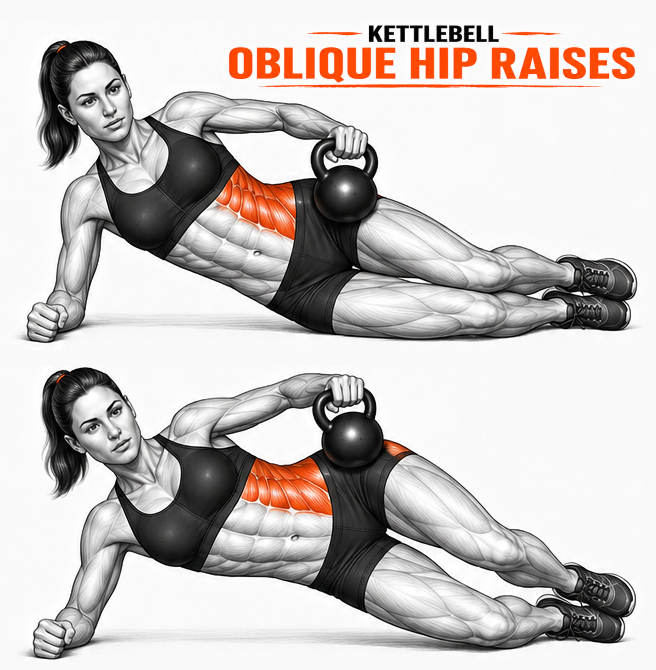
A side-plank hip raise loaded with a kettlebell, building the obliques and lateral trunk through a strong contraction.
Level: Intermediate
Primary: Abs
Secondary: Shoulder
Movement: Isolation
Tags: Hinge
Type: ISO Strength (Weight Lifting)
Equipment: Kettlebell
Target muscles
The obliques and quadratus lumborum on the down side drive the hip raise, lifting the pelvis against the kettlebell's load, while the same muscles work isometrically to hold the side-plank line. The shoulder of the supporting arm stabilises the whole position. It's targeted lateral-core strength with both a moving and a holding component.
How to perform
Setup
Set up in a side plank on the forearm, body in a straight line, feet stacked or staggered. Rest a kettlebell on the top hip, or hold it, depending on the variation. Brace the core.
Execution
Lower the hips toward the floor under control, then drive them back up by contracting the down-side obliques, lifting the pelvis to a straight or slightly raised line against the load. Squeeze hard at the top, then lower again slowly. Keep the body in one plane — no rolling forward or back. Complete the reps on one side, then switch.
Common mistakes
- Letting the hips drift forward or back instead of staying stacked in one line.
- Using momentum to bounce the hips up rather than controlling the lift.
- Loading too heavy and collapsing the side-plank position.
- Skipping the bottom range and only doing tiny pulses.
Progressions and regressions
Regress to bodyweight side-plank hip raises, or hold a static side plank, to build the base. Progress by increasing the kettlebell load, slowing the tempo, or raising the top leg. Keep load moderate — the obliques respond to controlled tension, not maximal weight.
Programming notes
Program it as oblique and lateral-core accessory work, 3 sets of 8-12 per side, balanced left and right. It pairs well with rotational and anti-rotation work for complete trunk training. Keep both sides even to avoid building a lateral imbalance.