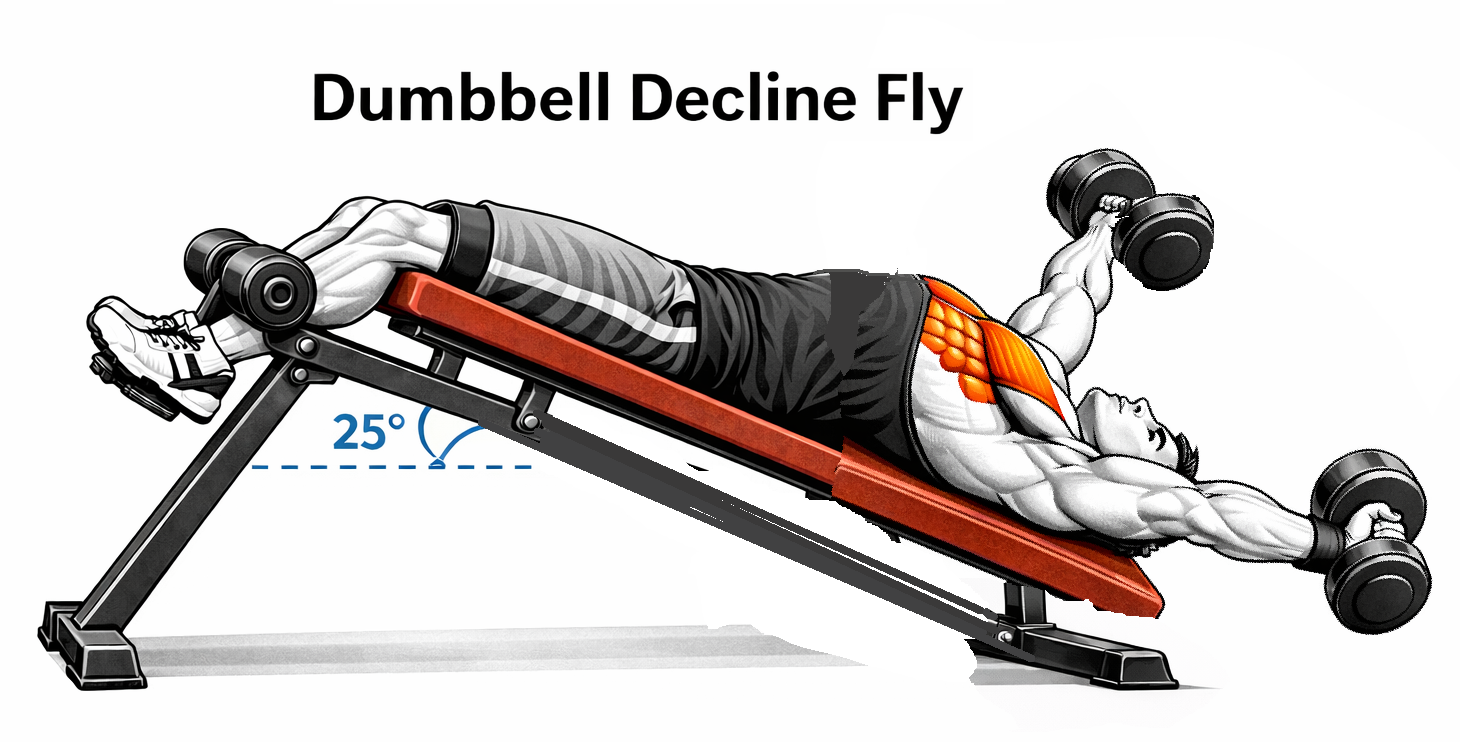
Dumbbell Decline Fly
Decline dumbbell fly biasing the lower chest — chest isolation through a long arc with the pec fibers loaded in their preferred direction.
Level: Beginner
Primary: Chest
Secondary: Shoulder Triceps
Movement: Isolation
Tags: Push
Type: Strength (Weight Lifting)
Equipment: Dumbbell
Sports: Football Swimming
Target muscles
The lower (sternocostal) head of the pectoralis major takes the largest share of the work thanks to the decline angle. The anterior deltoid contributes lightly. The biceps grip the dumbbells. The serratus anterior holds the scapulae stable. As a fly variation, this loads the chest through pure adduction — the elbow angle stays consistent through the rep, so the work concentrates on horizontal arm motion rather than vertical pressing.
How to perform
Setup
Set a decline bench to a slight decline (15-30 degrees). Lie back with feet secured under the leg supports. Hold dumbbells with neutral grips (palms facing each other) above the chest, slight bend in the elbows that stays consistent. Trunk braced.
Execution
Lower the dumbbells out to the sides in a wide arc — the elbow bend stays consistent throughout. Stop when you feel a strong stretch in the chest; for most lifters, that's when the upper arms are roughly parallel to the floor. Pause briefly. Reverse the arc — bringing the dumbbells back together above the chest by contracting the pecs. Squeeze hard at peak contraction. Don't let the dumbbells crash together at the top; control them.
Common mistakes
- Bending the elbows more during the rep, converting the lift into a partial press. Maintain the consistent slight bend.
- Going too heavy. The chest works through a long lever; light strict reps are the right approach.
- Cutting the stretch. Let the dumbbells travel out to a real stretch position.
- Hunched shoulders at the top. Keep the chest up; the contraction comes from the pec.
- Setting the decline too steep. 15-30 degrees is enough; steeper changes the muscle emphasis significantly.
Progressions and regressions
Regress to flat dumbbell flyes until the pattern is automatic. Cable decline flyes provide constant tension. To progress, work pause flyes (3-second hold at peak contraction), or alternate decline fly with decline press for a combined chest stimulus.
Programming notes
Chest isolation after the main pressing. 3 sets of 12-15 reps. Once or twice a week. The lower chest is often well-developed in flat-bench-heavy programs but underdeveloped in incline-focused programs; decline flyes are useful for the latter. Pair with incline presses and standard flat bench for complete chest coverage.