Tuck Front Lever
The lats and braced abs hold a tightly tucked body face-up and horizontal under the bar, the entry point to the front lever family.
Want a bodyweight core workout?
Our wizard builds one around your time, goal, and equipment in about two minutes. Free — no signup needed.
Make Me a Workout → Just did it? Track your sets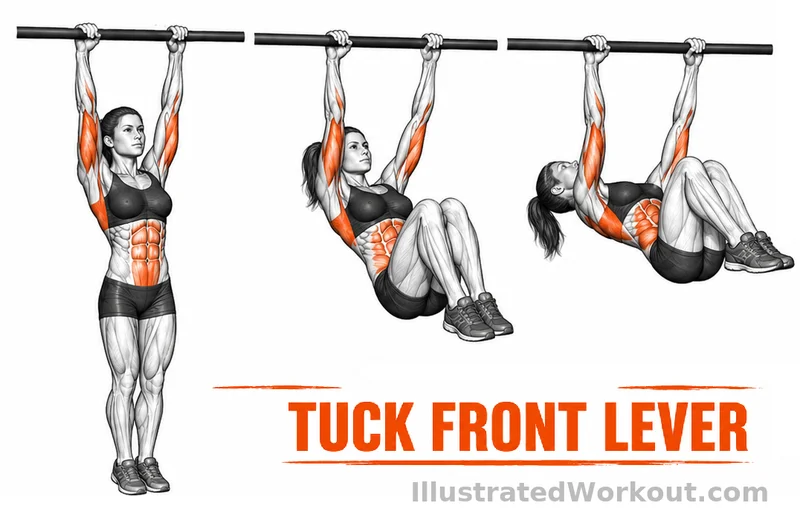
The lats and braced abs hold a tightly tucked body face-up and horizontal under the bar, the entry point to the front lever family.
Level: Advanced
Primary: Abs Back - Upper
Secondary: Biceps Forearms Shoulders - Rear
Movement: Compound
Tags: Core Stability
Type: ISO
Equipment: Body Weight
Target muscles
A tightly curled tuck keeps the lever at its shortest, which is why it opens the front lever family, yet the lats and teres major already fire hard through a straight-arm pull to hold the compact torso level and face-up. The rectus abdominis and hip flexors brace to keep the tuck horizontal and resist the extension that drops the hips, building the anti-extension core strength every front lever variation needs. The rear deltoids and biceps stabilise the straight arms while the forearm flexors grip the bar.
How to perform
Setup
Hang from a bar with a shoulder-width overhand grip and pull the shoulder blades down and back. Curl the knees tightly to the chest and round into a compact tuck. Straighten the arms, tilt the pelvis under, and brace the abs before lifting the torso to horizontal.
Execution
Pull the straight arms down toward the hips to lift the tucked body until the torso is parallel with the floor, face-up, knees held tight to the chest. Drive the bar down through the lats rather than bending the elbows, and keep the shoulders depressed instead of shrugging. Hold the hips level with the shoulders by bracing the abs, so the compact body stays flat rather than tilting. Keep the tuck tight to preserve the short lever, breathe in short controlled breaths, and end the set the moment the shoulders shrug, the hips drop or the elbows soften.
Common mistakes
- Letting the shoulders shrug up toward the ears so the lats disengage and the load hangs off the joint.
- Allowing the knees to slide away from the chest, lengthening the lever before the strength is there.
- Bending the arms to muscle the torso up rather than holding a straight-arm pull from the lats.
- Letting the hips sag or the tuck tilt instead of holding the compact body level with the shoulders.
Progressions and regressions
Regress to tuck front lever raises or to inverted hangs and scapular pulls to build the straight-arm pull first. Progress by opening the hips into the advanced tuck and frog tuck front levers, then the straddle and full holds. Weighted tuck holds and straight-arm pulldowns strengthen the lats for the longer levers to come.
Programming notes
Program it as the foundational front lever, trained early in a pull session while the lats, core and grip are fresh. Accumulate time across sets of ten to fifteen seconds rather than one long grind, and build volume steadily. Two or three exposures a week drive progress. It is the base of the whole front lever family, so groove a clean, level tuck with depressed shoulders here before opening the hips toward the advanced tuck.