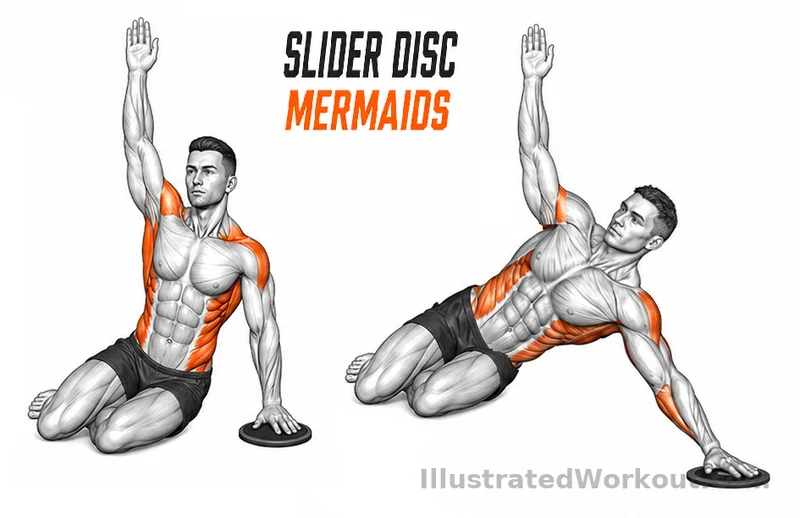
Disc Slider Mermaids
A side-plank slide where the stacked legs glide out and back, forcing the obliques to fight side-flexion and hold the torso rigid.
Want a disc sliders core workout?
Our wizard builds one around your time, goal, and equipment in about two minutes. Free — no signup needed.
Make Me a Workout → Just did it? Track your setsA side-plank slide where the stacked legs glide out and back, forcing the obliques to fight side-flexion and hold the torso rigid.
Level: Advanced
Primary: Abs
Secondary: Adductors Shoulder
Movement: Isolation
Tags: Anti-Rotation Core Stability
Type: Functional Fitness (Obstacle & Hybrid) ISO
Equipment: Disc Sliders
Target muscles
The obliques and the quadratus lumborum on the down side carry this one, resisting side-bend to hold the torso in a straight line while the legs travel. The gluteus medius of the top hip and the adductors of both legs work to control the sliding motion, and the anterior deltoid and lats of the supporting arm stabilise the shoulder. Because the base is so narrow, the deep core braces hard against both collapse and rotation throughout the slide.
How to perform
Setup
Set up in a side plank on one forearm with the feet on sliders, legs stacked and the body in a straight line from head to heels. Drive the down elbow into the floor to lift the ribs away from the shoulder, brace the obliques and squeeze the glutes. Set the top hand on the hip or reach it toward the ceiling for balance.
Execution
Holding the side-plank line, glide both feet forward and back, or sweep the legs out and return, keeping the hips high and the torso from folding toward the floor. Move slowly so the obliques control the whole range, and keep the shoulders and hips stacked rather than rotating open. Breathe steadily and think about pushing the down hip up toward the ceiling the entire time. The moment the hips start to sag, reset and continue only if the line can hold.
Common mistakes
- Letting the down hip sag toward the floor instead of driving it up to hold the side-plank line.
- Rotating the torso open or closed rather than keeping the shoulders and hips stacked.
- Sliding the legs with momentum so the obliques stop controlling the range.
- Sinking into the supporting shoulder instead of pushing the elbow down to lift the ribs.
Progressions and regressions
Regress to a static side plank, or to a side plank with the top foot in front for a wider, steadier base, before adding the slide. Bent knees on the floor lower the load further. Progress by widening the leg sweep, slowing the tempo, pausing at the far range, or raising the top leg into a star position for a much harder anti-lateral-flexion challenge.
Programming notes
Use it as advanced lateral-core and anti-rotation work, two to three sets of six to ten slow reps per side. Place it after heavier lifting when the trunk is fresh, since a fatigued side plank collapses quickly. Build a solid static side plank first, and end the set as soon as the hip sags rather than grinding, because a dropping side plank loads the lumbar spine unevenly.