Battle Ropes Around The World
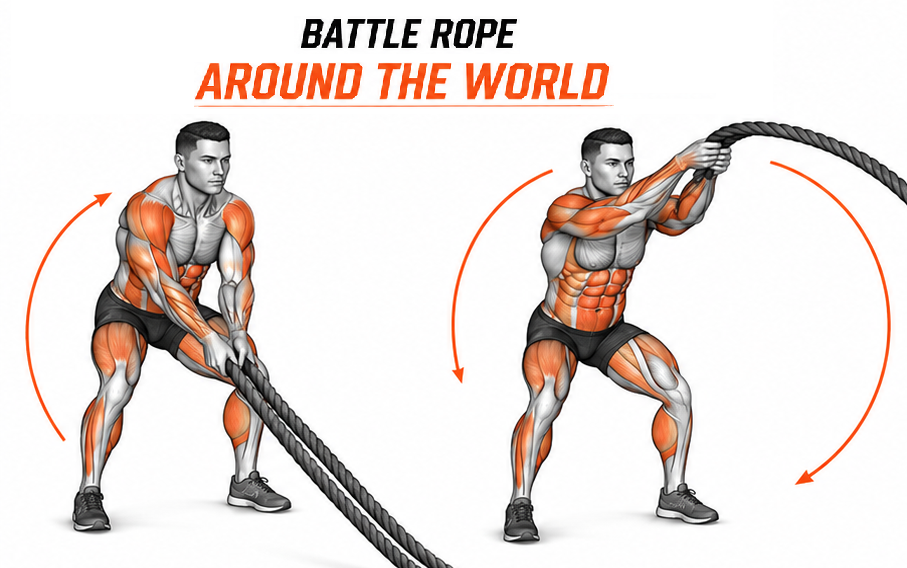
The deltoids sweep both rope ends in a wide circle around the head while the obliques drive the rotation and the grip holds on hard.
Level: Intermediate
Primary: Shoulder
Secondary: Abs Back - Upper Forearms
Movement: Compound
Tags: Rotational
Type: Aerobic (Cardio) Anaerobic Intervals (HIIT / Bootcamp / Circuit)
Equipment: Battle Ropes
Target muscles
The deltoids carry the load as both arms swing the rope ends in a large circle overhead and around the body, with the anterior and lateral heads working hardest at the top and side of the arc. The obliques and rotational core musculature power the sweep and decelerate it on each pass, while the forearm grip and the upper back hold the rope under control. The continuous large arc keeps the shoulders under tension and the heart rate elevated throughout the interval.
How to perform
Setup
Hold both rope ends together or one in each hand and stand far enough back to keep light tension on the line. Set a shoulder-width stance with the knees softly bent and the core braced, the chest tall and the shoulders set down. Start with the ropes low and to one side of your hips, your weight balanced through the midfoot, ready to swing them up and across in a wide, controlled arc.
Execution
Sweep both ends up and around in a big circle that travels overhead and back down the other side, letting the trunk rotate with the arc rather than staying rigid. Keep the circle wide and continuous, driving the rope with the shoulders while the obliques control the turn. After a set time or count, reverse direction so you circle the other way and train both rotational paths evenly. Keep the feet planted and let the hips and spine rotate smoothly, never snapping the lower back to force the rope around.
Common mistakes
- Whipping the lower back around to drag the rope rather than driving the arc from the shoulders and obliques.
- Letting the circle collapse small and fast instead of keeping it big and powerful.
- Forgetting to reverse direction, so one rotational pattern is over-trained.
- Ducking the head or losing posture as the ropes pass overhead.
Progressions and regressions
Regress to inside or outside circles, which keep the arc smaller and lower, until the overhead path feels controlled, or shorten the interval so posture holds. Progress by widening the circle, speeding the cadence, or extending the work bout. Splitting the ropes into one end per hand raises the coordination demand sharply compared with holding both ends together, and dropping into a deeper athletic stance adds a lower-body and core challenge on top of the rotational shoulder work.
Programming notes
Program it in 20-40 second intervals, splitting the time evenly between clockwise and counter-clockwise, for 3-6 rounds against matched rest. It fits a conditioning circuit or a shoulder-and-core finisher, and works as a dynamic warm-up for the shoulders before pressing. Because the arc loads the shoulders at end range, keep the amplitude controlled, build the speed gradually, and stop if the shoulder feels pinched rather than powering through a painful range.