Battle Ropes Lateral Raises
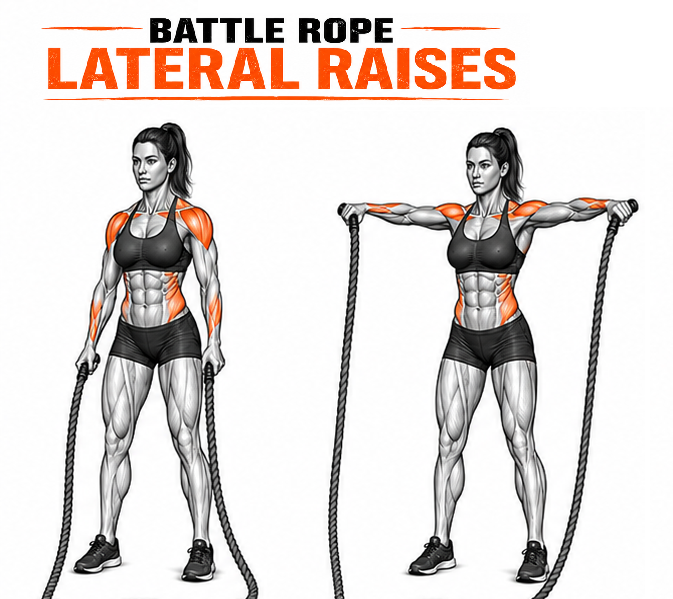
The lateral deltoids raise both rope ends out to shoulder height for reps, an isolation-style burn driven by the weight and drag of the rope.
Level: Foundation
Primary: Shoulder
Secondary: Forearms Traps
Movement: Isolation
Type: Anaerobic Intervals (HIIT / Bootcamp / Circuit) Strength (Weight Lifting)
Equipment: Battle Ropes
Target muscles
The lateral deltoids are the focus, abducting both arms to lift the rope ends out to the sides against the weight and drag of the rope. The traps and supraspinatus assist at the start of the raise, and the forearm flexors grip throughout while the upper back stabilises the shoulder girdle. Because the rope provides continuous resistance and the reps come quickly, the shoulders also get a conditioning stimulus on top of the isolation work, keeping the heart rate up.
How to perform
Setup
Stand on or near the middle of the rope, or hold both ends with the rope draped to create resistance, the arms down at your sides. Set a shoulder-width stance, soften the knees, and brace the trunk with the chest tall and the shoulders set down and back. Take a soft bend in the elbows, fix your eyes forward, and find the rope tension before the first rep so the side delts are loaded from the very start.
Execution
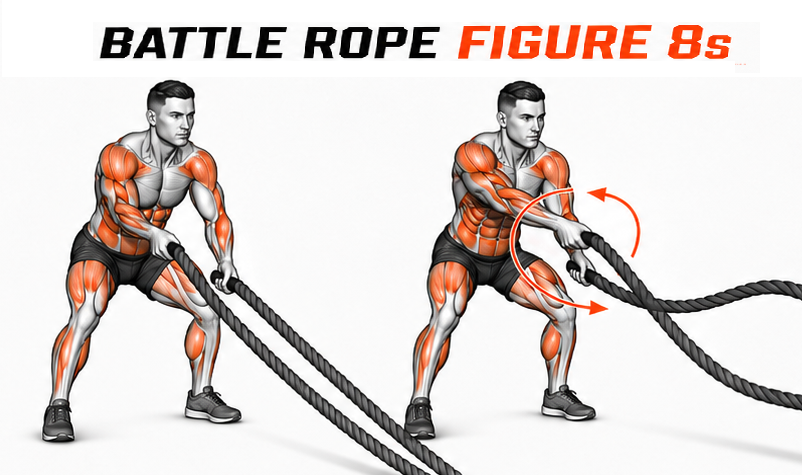
Raise both rope ends out to the sides up to about shoulder height, leading with the elbows and keeping a slight bend in the arms, just as in a dumbbell lateral raise. Pause briefly at the top with the arms roughly parallel to the floor, then lower under control and repeat at a steady pace. Keep the torso upright and avoid swinging or shrugging the rope up. Drive the movement from the side delts and let the rope's drag provide the resistance through the full range.
Common mistakes
- Swinging the torso or using momentum to fling the ropes up instead of raising them with the delts.
- Shrugging the shoulders toward the ears and turning it into a trap-dominant movement.
- Raising the arms well above shoulder height, which shifts work off the lateral delts.
- Letting the elbows drop below the wrists so the delts disengage at the top.
Progressions and regressions
Regress by using a lighter rope, standing closer to slacken the drag, or reducing the reps until the form stays clean. Progress by increasing the rope weight or tension, slowing the lowering phase, or pausing at the top of each rep for a harder peak contraction. Adding a continuous wave between raises blends isolation with conditioning, and a single-arm version lets you chase any side-to-side imbalance in the delts directly.
Programming notes
Program it as shoulder accessory or conditioning, 2-4 sets of 12-20 reps or 20-40 second intervals at a controlled tempo. It pairs well after pressing as a side-delt finisher, or inside a conditioning circuit between heavier stations. Keep the load and the reps where form stays clean, since the lateral delts respond to control and continuous tension rather than heaving heavy rope.