Advanced Tuck Front Lever
Opening the tuck a stage wider, the lats and deep core suspend a partly opened body face-up and horizontal, a demanding step toward the full front lever.
Want a bodyweight core workout?
Our wizard builds one around your time, goal, and equipment in about two minutes. Free — no signup needed.
Make Me a Workout → Just did it? Track your sets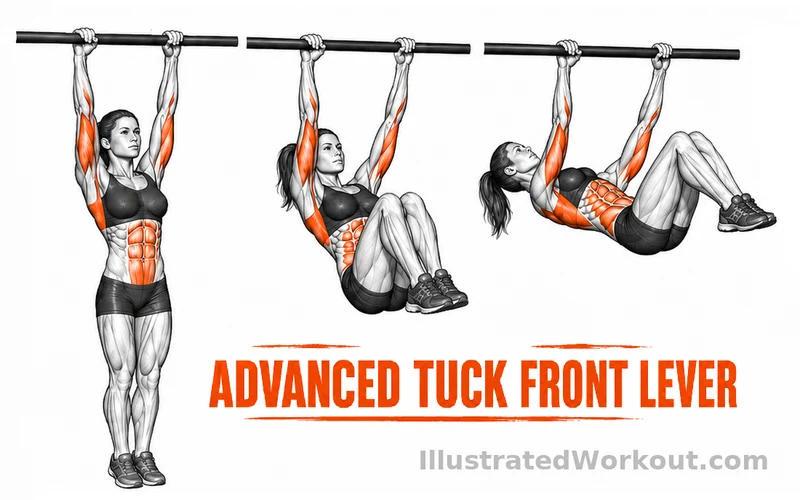
Opening the tuck a stage wider, the lats and deep core suspend a partly opened body face-up and horizontal, a demanding step toward the full front lever.
Level: Advanced
Primary: Abs Back - Upper
Secondary: Biceps Forearms Shoulders - Rear
Movement: Compound
Tags: Core Stability
Type: ISO
Equipment: Body Weight
Target muscles
Opening the hips out of the basic tuck shifts the centre of mass away from the bar, and the lats and teres major answer by working far harder to hold the body face-up and horizontal through a straight-arm pull toward the hips. The rectus abdominis and hip flexors brace fiercely to resist the extension that wants to drop the hips into a sag, giving the front lever its enormous anti-extension core demand. The rear deltoids, biceps and gripping forearms all contribute.
How to perform
Setup
Hang from a bar with a shoulder-width overhand grip and pull the shoulder blades down and back. Tuck the knees, then open the hips so the thighs sit around ninety degrees to the torso. Straighten the arms, tilt the pelvis under into a hollow, and brace hard before lifting to horizontal.
Execution
Pull the straight arms down toward the hips to raise the torso until it is parallel with the floor, face-up, with the knees held away from the chest in the opened tuck. Keep the arms locked and drive the bar down using the lats rather than bending the elbows. Fight to keep the hips level with the shoulders by bracing the abs and posteriorly tilting the pelvis. Hold the hollow line, breathe in short controlled breaths, and end the set the moment the hips drop or the elbows soften.
Common mistakes
- Letting the hips sag into a sway-back because the abdominals give out before the lats, which breaks the horizontal line.
- Retracting the knees toward the chest under fatigue, shortening the lever and softening the intended difficulty.
- Bending the arms and hollowing at the shoulder instead of holding a strong straight-arm pull.
- Losing scapular depression so the shoulders creep toward the ears and the lats disengage.
Progressions and regressions
Regress to the tuck front lever with the knees pinned to the chest for the shortest lever, or to tuck front lever raises to build pulling strength. Progress toward the frog tuck and then the straddle front lever, splitting the legs to keep the lever workable as it lengthens. Straight-arm pulldowns and weighted tuck holds develop the underlying lat strength.
Programming notes
Slot it in as an advanced skill and core-strength piece early in a pull session, when the lats and grip are fresh. Accumulate time across sets of eight to fifteen seconds rather than grinding a single hold to failure. Two or three exposures a week drive progress. It is the workhorse step between the tuck and the straddle, so spend real time here before opening the legs further.