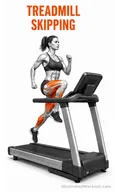
Treadmill Single-Leg Hops
Continuous hops on one leg along a slow belt, training ankle stiffness, single-leg balance and calf power while the heart rate climbs.
Want a treadmill conditioning workout?
Our wizard builds one around your time, goal, and equipment in about two minutes. Free — no signup needed.
Make Me a Workout → Just did it? Track your setsContinuous hops on one leg along a slow belt, training ankle stiffness, single-leg balance and calf power while the heart rate climbs.
Level: Intermediate
Primary: Cardio
Secondary: Calves Quads
Movement: Isolation
Tags: Balance / Stability Unilateral
Type: Anaerobic Intervals (HIIT / Bootcamp / Circuit) Plyometric
Equipment: Treadmill
Target muscles
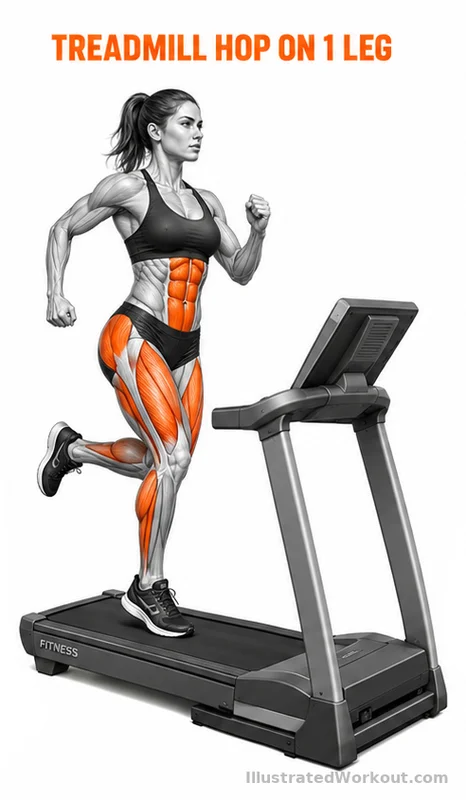
Repeated hopping on one leg loads the calf complex heavily as the gastrocnemius and soleus store and return energy at each contact, while the quad and glute of the support leg absorb landing forces. The foot and ankle stabilisers fire constantly to keep balance on the moving belt, and the core braces to hold the torso steady. Working one leg at a time makes it a genuine balance and single-leg conditioning drill.
How to perform
Setup
Set the belt slow, or run it manually, and hold a rail to establish your balance before committing to one leg. Stand on the working leg with a soft knee, weight on the ball of the foot, and the other foot lifted. Stack the ribs over the hips and brace the trunk so the torso stays quiet.
Execution
Hop repeatedly on the single leg, staying tall and springing off the forefoot with short, elastic contacts as the belt moves under you. Keep the hopping rhythm steady and the landings soft, letting the ankle and knee absorb and return each bounce. Hold the free leg tucked and the hips level, resisting any twist. Use a light rail touch for balance early on, then progress to hopping unassisted. Switch legs to train both sides evenly, and stop if the ankle fatigues to the point of sloppy landings.
Common mistakes
- Landing stiff and flat instead of springing softly off the ball of the foot.
- Letting the support knee cave inward or the hip drop out of line on each landing.
- Setting the belt too fast, which drags the foot back and makes single-leg balance unsafe.
- Neglecting to train both legs equally, reinforcing a side-to-side imbalance.
Progressions and regressions
Regress to two-foot bounces on the belt, or to stationary single-leg hops on the floor holding a rail. Progress by hopping unassisted, increasing the duration, or picking up the belt speed slightly for more travel. Hopping in a slight zigzag or over a low line adds a reactive challenge for advanced trainees.
Programming notes
Program it as plyometric and balance conditioning, short bouts of fifteen to thirty seconds per leg for three to five rounds, keeping quality high rather than grinding. It builds ankle stiffness and single-leg control useful for running and cutting sports. Keep the belt slow, hold a rail until steady, and avoid it on a sprained or reactive ankle, since it is repeated single-leg impact.