Treadmill Skipping
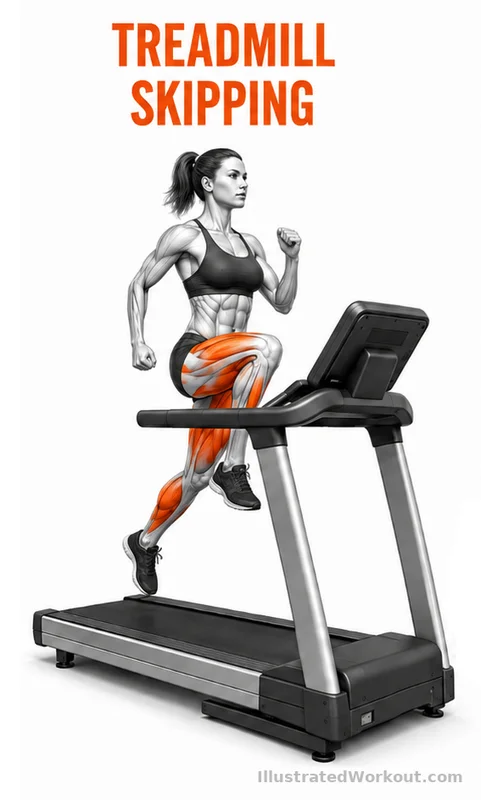
A springy skip travelling the belt with a bounding hop between steps, building calf elasticity and rhythm while lifting the heart rate.
Want a treadmill conditioning workout?
Our wizard builds one around your time, goal, and equipment in about two minutes. Free — no signup needed.
Make Me a Workout → Just did it? Track your setsA springy skip travelling the belt with a bounding hop between steps, building calf elasticity and rhythm while lifting the heart rate.
Level: Foundation
Primary: Cardio
Secondary: Calves
Movement: Isolation
Type: Aerobic (Cardio) Plyometric
Equipment: Treadmill
Target muscles
Skipping strings together a hop and a step, so the calves take centre stage, springing the body up off each forefoot contact, while the quads and hip flexors drive the knee up on the airborne phase. The glutes extend the support hip and the core keeps the torso tall between bounds. Repeated continuously, the elastic bounce raises the heart rate and trains the springy stiffness that fast running relies on.
How to perform
Setup
Set a slow belt speed and hold a rail lightly as you find the skipping rhythm, or begin nearly in place at the front of the deck. Stand tall on the balls of the feet, chest up, with the arms bent ready to swing. Brace the trunk so the torso stays upright through the bounce.
Execution
Skip forward along the belt with a step-hop rhythm, driving one knee up as you spring off the opposite forefoot, then landing and repeating on the other side. Stay light and elastic, keeping ground contacts short and springy rather than heavy. Swing the arms in time to help the rhythm and lift. Hold the torso tall and let the ankles do the springing, absorbing and returning each contact. Keep the belt slow enough to stay in rhythm and step off safely if the timing slips.
Common mistakes
- Landing flat and heavy instead of springing off the balls of the feet, which kills the elastic bounce.
- Setting the belt too fast so the skip rhythm breaks down into an unsafe stumble.
- Collapsing the torso forward rather than staying tall and letting the knee drive lift.
- Letting the arms hang instead of swinging them to reinforce the skipping rhythm and height.
Progressions and regressions
Regress to a low, gentle skip nearly in place with a hand on the rail, keeping the hop small. Progress by increasing the height of the knee drive and hop, extending the duration, or picking up the belt speed for more travel. Exaggerating the bound into a power skip makes it a more plyometric drill for advanced trainees.
Programming notes
Use it as a plyometric warm-up primer or light conditioning, twenty to forty second bouts for a few rounds, often before sprint or jump work. It develops ankle elasticity and coordination in an accessible, low-load way. Keep the contacts springy and the belt modest, and ease off if the calves or Achilles are tender, since it is repeated forefoot rebounding.