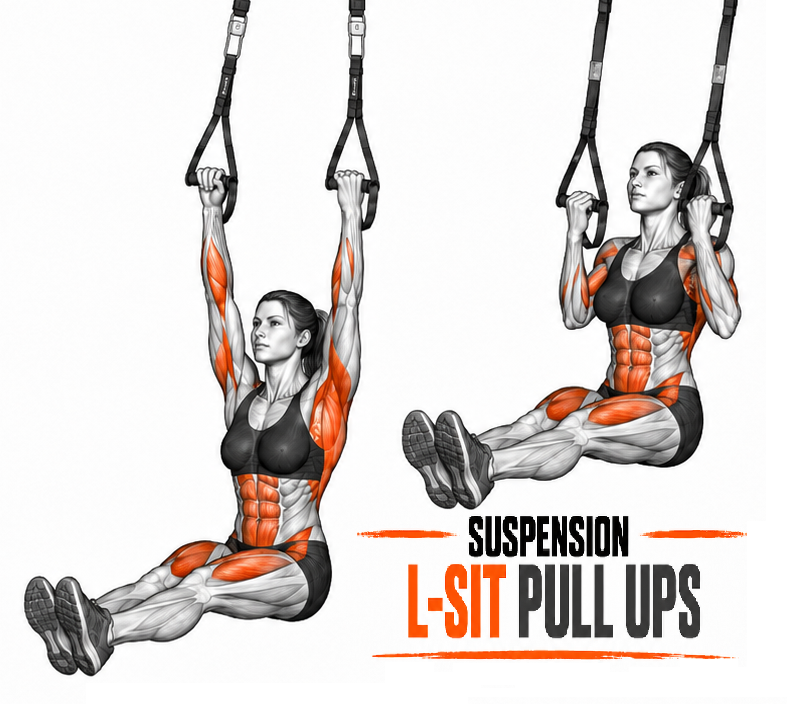
Suspension L-Sit Pullups
The lats and biceps pull the body up on rings while the abs hold the legs locked out in an L-sit — elite pulling and core strength.
Level: Elite
Primary: Back - Upper
Secondary: Abs Biceps Shoulders - Rear
Movement: Compound
Tags: Core Stability Pull
Type: Functional Fitness (Obstacle & Hybrid) Strength (Weight Lifting)
Equipment: Suspension
Target muscles
The latissimus dorsi, rhomboids and lower traps drive the pull-up while the biceps and forearms flex the arms and grip the handles, and the rear delts assist at the top. Underneath it all, the rectus abdominis and hip flexors fight a brutal isometric battle to hold the legs straight out at hip height, while the obliques and deep core keep the suspended body from swinging on the unstable straps. Holding the L-sit through a full pull-up demands the entire trunk and the pulling chain at once.
How to perform
Setup
Hang from rings or a suspension trainer with a firm grip and the arms fully extended, shoulders packed down away from the ears. Brace the core hard and raise both legs straight out in front until they are parallel to the floor, forming a sharp L with the torso. Find a still, controlled hang before you pull.
Execution
Keeping the legs locked out at hip height, pull through the lats and bend the arms to drive your chest toward the handles, leading with the elbows and squeezing the shoulder blades down and together at the top. Hold the L-sit rigid the entire time — the legs must not drop or kick. Lower under full control back to the dead hang without losing the leg position, and resist any swing the straps invite. Each rep is a pull-up and a maximal core hold fused together; move deliberately and keep the body quiet.
Common mistakes
- Letting the legs drop out of the L to make the pull easier, which abandons the core demand entirely.
- Kipping or swinging on the straps instead of pulling strictly from a controlled hang.
- Shrugging the shoulders up toward the ears rather than packing them down to start the pull.
- Cutting the range short at the top instead of driving the chest to the handles.
Progressions and regressions
Regress by separating the pieces: train strict suspension pull-ups and floor or hanging L-sit holds independently, then combine a tuck-leg pull-up before extending to the full L. A hanging knee-tuck pull-up is the standard stepping stone. Progress by adding pause reps at the top, slowing the eccentric, or building toward strict consecutive reps. This is an elite movement — own strict pull-ups and a solid L-sit hold first.
Programming notes
Program it as low-volume, high-skill strength work, 3-5 sets of 3-6 quality reps, early in a session when grip and core are fresh. Fatigue wrecks the L-sit position fast, so stop the set when the legs start to sag rather than grinding ugly reps. It suits advanced calisthenics and gymnastics-style training; skip it until strict pull-ups and the L-sit are both genuinely comfortable.