Sandbag Russian Twist
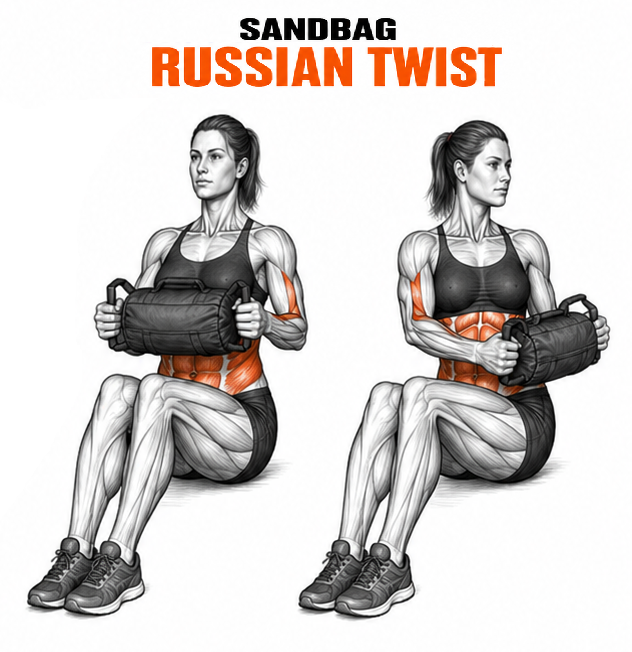
The obliques drive this seated sandbag twist, rotating a shifting load hip to hip for a deep rotational-core burn.
Level: Foundation
Primary: Abs
Secondary: Shoulder
Movement: Isolation
Tags: Rotational
Type: Strength (Weight Lifting)
Equipment: Sandbag
Target muscles
The internal and external obliques produce the rotation that carries the bag from hip to hip, with the rectus abdominis and transverse abdominis bracing to hold the leaned-back torso position. The shifting sand inside the bag changes the load slightly as it moves, so the trunk works harder to start and stop each rotation than it would with a rigid weight. The hip flexors hold the legs up if you raise the feet.
How to perform
Setup
Sit on the floor with your knees bent, holding the sandbag at your chest. Lean your torso back to around 45 degrees so the abs come under tension, and keep a long, flat spine rather than a rounded slump. Plant the heels down, or raise them for more difficulty.
Execution
Rotate your trunk to one side and lower the bag toward the floor beside that hip, turning from the waist rather than just swinging the arms. Tap or stop the bag near the hip, then reverse and rotate to the opposite side under control. Keep the chest up and the back flat throughout, and let the obliques drive each turn rather than throwing the bag with momentum. Breathe steadily and keep the leaned-back angle constant so the abs stay loaded between reps.
Common mistakes
- Swinging the arms side to side while the torso barely rotates, which removes the oblique work.
- Rounding the lower back into a slump instead of holding a long, braced spine.
- Sitting too upright so the abs come off tension between reps.
- Rushing the rotation and letting momentum, not the core, move the bag.
Progressions and regressions
Regress by keeping the heels planted, using a lighter bag, or reducing the range of rotation until the form holds. Progress by raising the feet off the floor, adding filler, or slowing each rotation for more time under tension. Touching the bag fully to the floor on each side, or extending the arms for a longer lever, ramps the difficulty further.
Programming notes
Use it as rotational-core accessory work, 3 sets of 12-20 total reps or 10-15 per side, counted evenly left and right. It slots in well on a core day alongside an anti-rotation hold so you train both producing and resisting twist. Keep the load light to moderate — control and a tall spine matter more than weight, and a slumped, heavy twist is hard on the lower back.