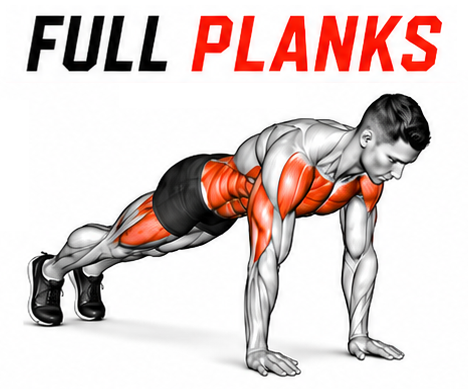
Full Planks
The standard straight-body plank — an isometric hold that teaches the entire anterior core to brace and keep the spine neutral under load.
Level: Beginner
Primary: Abs
Secondary: Shoulder
Movement: Isolation
Tags: Core Stability
Type: ISO
Equipment: Body Weight
Target muscles
The rectus abdominis and transverse abdominis hold the spine neutral against the pull of gravity, which is the core's most important real-world job: resisting extension rather than producing flexion. The obliques assist, the glutes and quads stay engaged to keep the hips level, and the shoulders, chest and serratus anterior support the upper body. Done well it is a whole-body bracing drill disguised as an ab exercise.
How to perform
Setup
Set the forearms on the floor with elbows directly under the shoulders, or take a straight-arm position with hands under the shoulders. Extend the legs back and rise onto the toes so the body forms one straight line from heels to head. Set the feet hip-width for a stable base.
Execution
Brace the abs as if bracing for a punch, tuck the pelvis slightly so the lower back sits neutral, and squeeze the glutes and quads. Press the forearms or hands into the floor to push the upper back broad, and keep the neck long with the gaze just ahead of the hands. Hold this rigid line and breathe in shallow, controlled breaths — the body should not sag or pike. Every second is an active brace, not a passive rest; the moment the hips drop or rise, the hold is over.
Common mistakes
- Letting the hips sag toward the floor so the lower back takes the strain instead of the abs.
- Piking the hips up to make the hold easier and offload the core.
- Holding the breath entirely, which spikes tension and shortens the hold.
- Craning the neck up or letting the head drop, breaking the long spinal line.
Progressions and regressions
Regress to a plank from the knees or with the hands elevated on a bench to shorten the lever until a clean line holds for thirty seconds. Progress by extending the hold time, lifting one foot or one hand, or adding shoulder taps and reaches. Long-lever and weighted planks raise the difficulty once the basic hold is rock-solid.
Programming notes
Program it as core stability work, three to four sets of twenty to sixty seconds, or as a warm-up to switch the brace on before lifting. End each set when the line breaks rather than chasing a shaking record — a strict thirty seconds beats a sloppy two minutes. It pairs naturally with anti-rotation work to cover the full set of core stability demands.