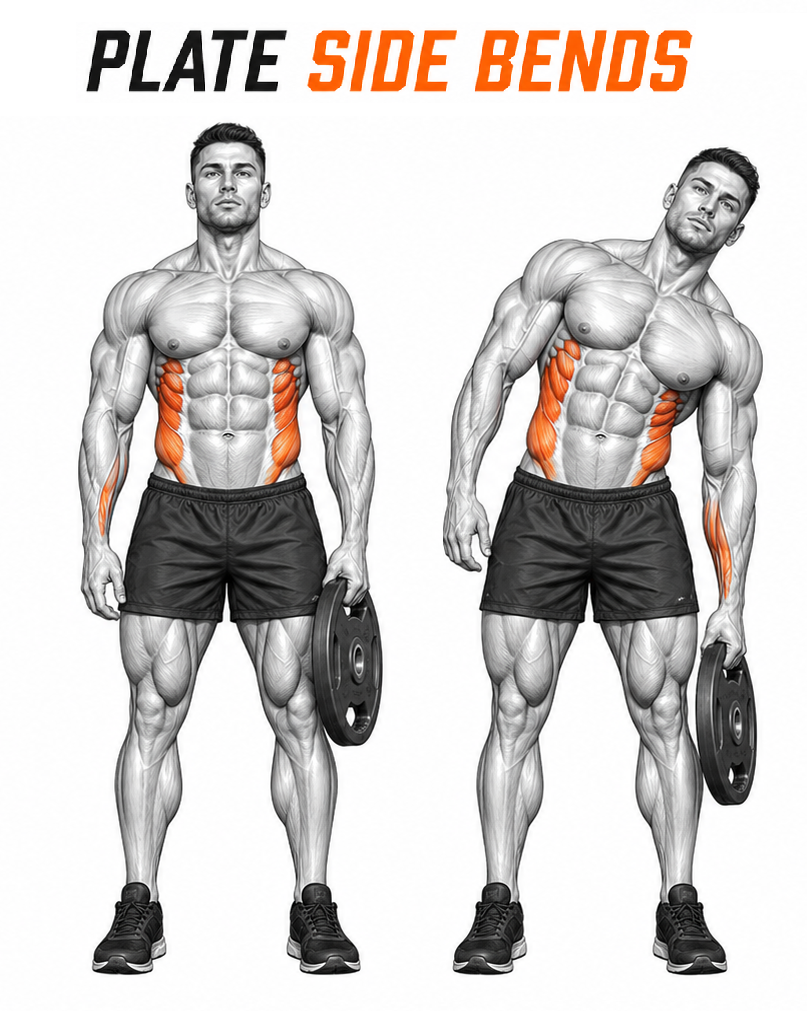
Plate Side Bends
A standing side bend holding a plate at one side, isolating the obliques through lateral flexion to build and strengthen the waist.
Level: Beginner
Primary: Abs
Movement: Isolation
Type: Strength (Weight Lifting)
Equipment: Plates
Target muscles
The obliques and the deeper quadratus lumborum on the working side produce the lateral flexion, bending the torso toward the plate and pulling it back upright. The opposite-side obliques control the return, and the rectus abdominis and transverse abdominis brace to keep the spine from rotating or hunching. It is a direct, simple way to strengthen the muscles that flex the trunk sideways and stabilise it against side loads.
How to perform
Setup
Stand tall with feet hip-width, holding a plate in one hand at your side and the other hand on your hip or behind your head. Brace the core, keep the shoulders level, and set a neutral spine.
Execution
Bend slowly toward the plate side, letting the plate travel down along the thigh while keeping the torso square — no leaning forward or twisting. Feel the stretch through the opposite-side waist, then contract the obliques to pull the torso back to upright. Keep the movement purely lateral, like sliding between two panes of glass. Complete the reps, then move the plate to the other hand and repeat to train both sides evenly.
Common mistakes
- Leaning forward or twisting instead of bending purely to the side.
- Using a plate so heavy the lower back compensates.
- Bouncing out of the bottom with momentum rather than controlling the bend.
- Holding a plate in each hand, which cancels the resistance and wastes the effort.
Progressions and regressions
Regress with a lighter plate or a shorter range. Progress by using a heavier plate, adding a pause at the stretched position, slowing the tempo, or holding a second weight overhead on the opposite side for greater demand.
Programming notes
Program it as oblique isolation, 2-3 sets of 10-15 reps per side, late in a session. Always work both sides equally and keep the load moderate, since the lower back is easily recruited if the weight is too heavy. It complements rotational and anti-rotation core work for complete development of the waist.