Sandbag Farmers Carry
Grip-and-posture loaded carry walking with a sandbag for time or distance, building forearm, trap and trunk endurance under an awkward load.
Level: Foundation
Primary: Forearms
Secondary: Abs Glutes Traps
Movement: Compound
Tags: Loaded Carry
Type: Functional Fitness (Obstacle & Hybrid)
Equipment: Sandbag
Target muscles
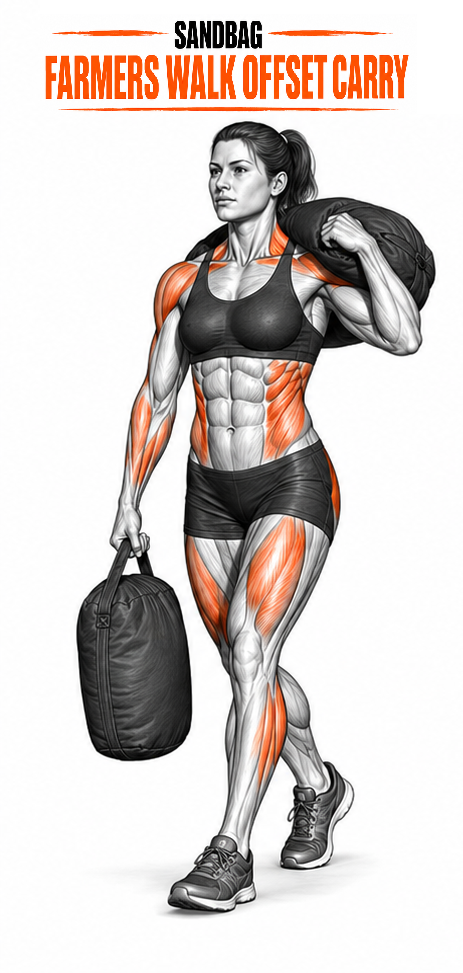
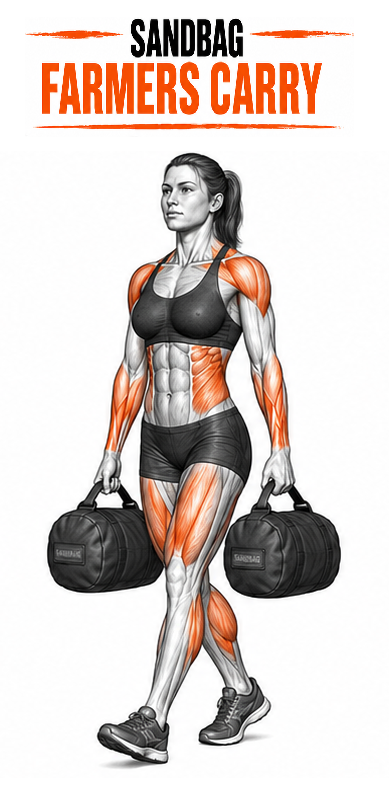
The forearm flexors and the entire grip carry the day here, holding the bag's bulky body or handles against a load that constantly tries to slip. The upper trapezius and the muscles around the shoulder girdle resist the downward pull and keep the shoulders from rounding, while the abs, obliques and spinal erectors brace the trunk to keep you tall. The glutes, quads and calves drive each stride. Carrying a soft, shifting bag adds a stabilising tax that fixed dumbbells never produce.
How to perform
Setup
Stand the bag up and either grip it by its side handles at your sides or hug it to your chest in a bear hug. Pull your shoulders back and down, brace the abs, and stand tall with the ribs stacked over the pelvis before you take the first step.
Execution
Walk forward with short, controlled, deliberate steps, keeping your posture upright and the bag steady. Resist the urge to lean back or hunch forward under the load — own a neutral, tall spine the whole way. Breathe steadily and keep the core braced so the trunk does not sway side to side. Walk for the prescribed time or distance, set the bag down under control, rest, and repeat. If the grip is the limiter, that is the point; keep the trunk rigid and let the forearms work.
Common mistakes
- Letting the shoulders round forward and the upper back collapse under the load.
- Leaning the torso back to counterbalance instead of bracing the abs and standing tall.
- Taking long, bouncy strides that let the bag sway and pull you off line.
- Holding the breath the whole way rather than breathing behind a steady brace.
Progressions and regressions
Regress with a lighter bag, a shorter distance, or a bear-hug hold that is easier to secure than handles. Progress by adding weight, extending the distance or time, or moving to an offset single-side carry for an anti-rotation challenge. Pairing it with a front-loaded zercher carry shifts the demand onto the upper back and core.
Programming notes
Program it as grip and postural conditioning, 3-5 rounds of 30-60 seconds or 20-40 metres. It finishes a session well or slots into a circuit between strength stations. Because it builds carryover to real-world lifting and loaded movement, it is worth running regularly. Stop a round when posture breaks rather than when the grip fully fails, so the trunk stays trained correctly.