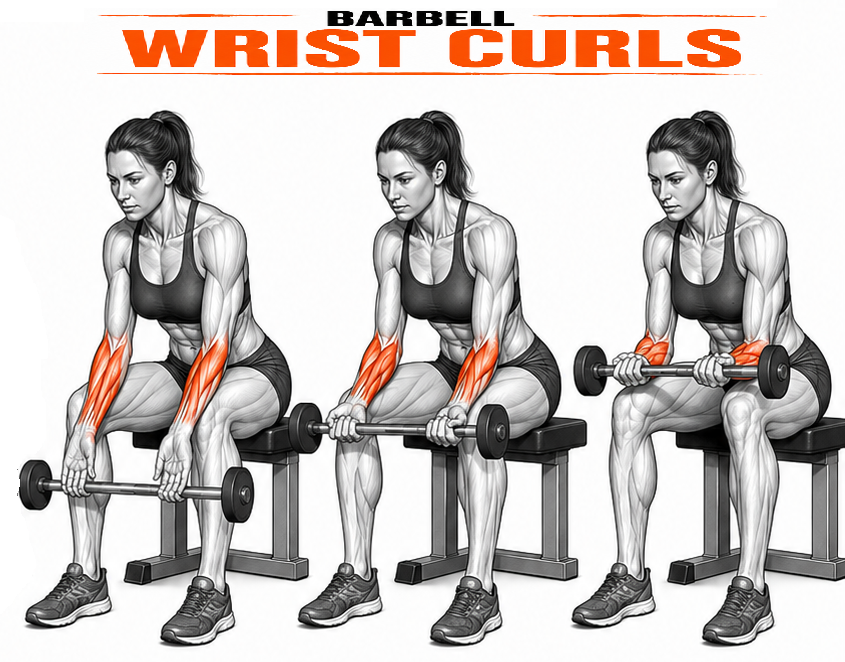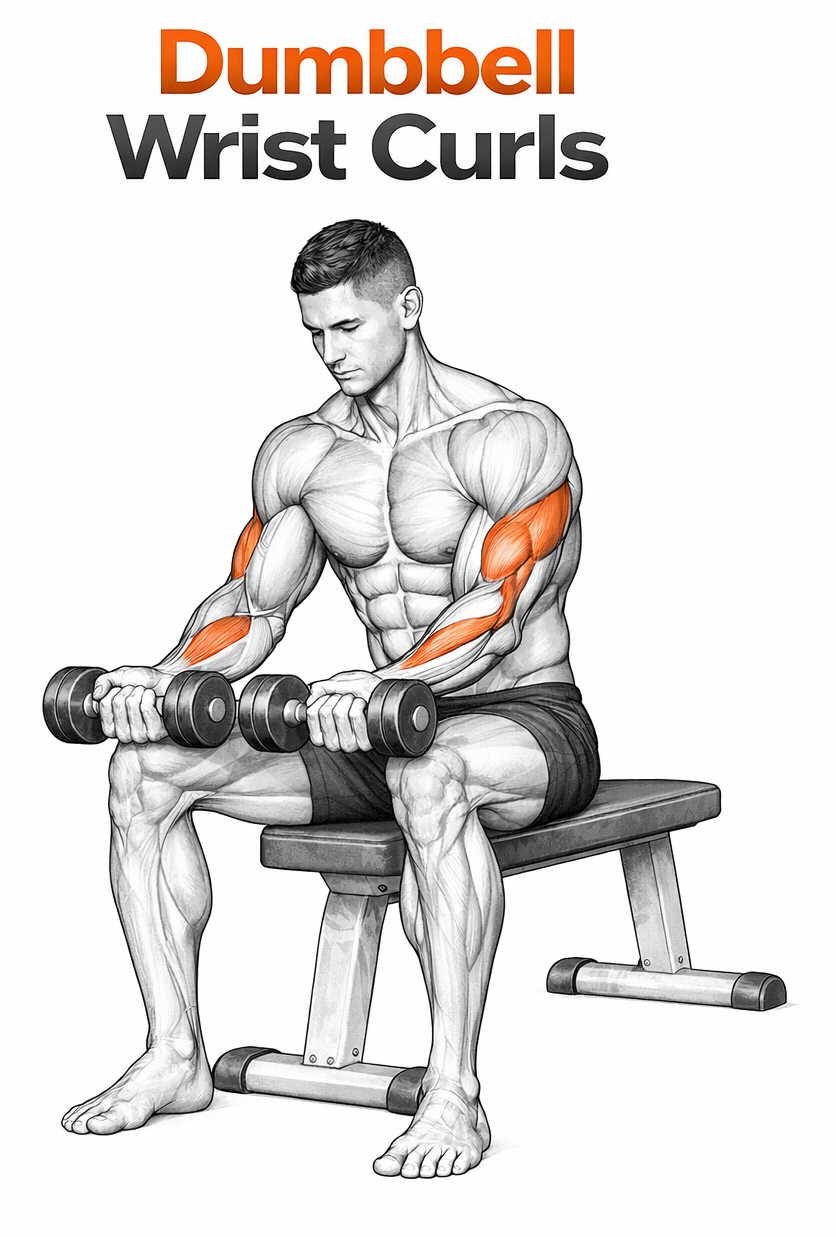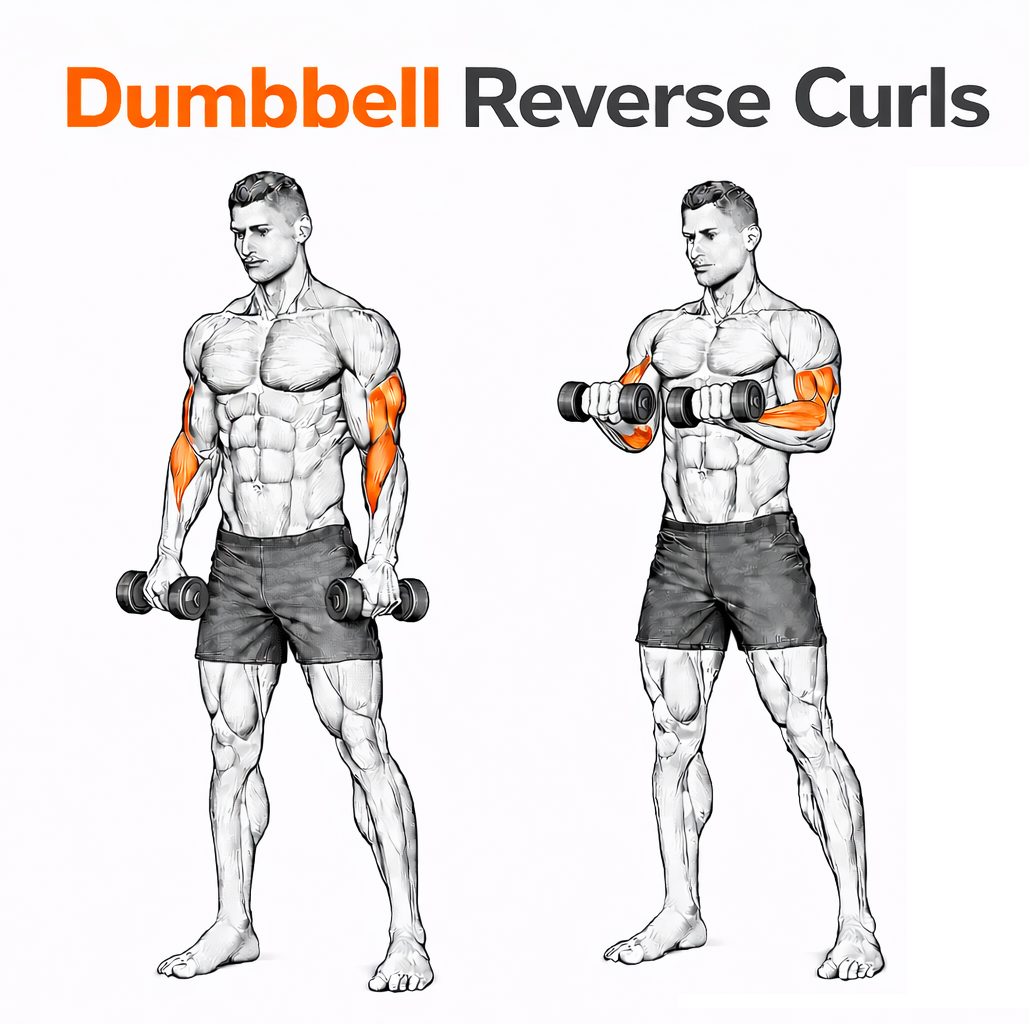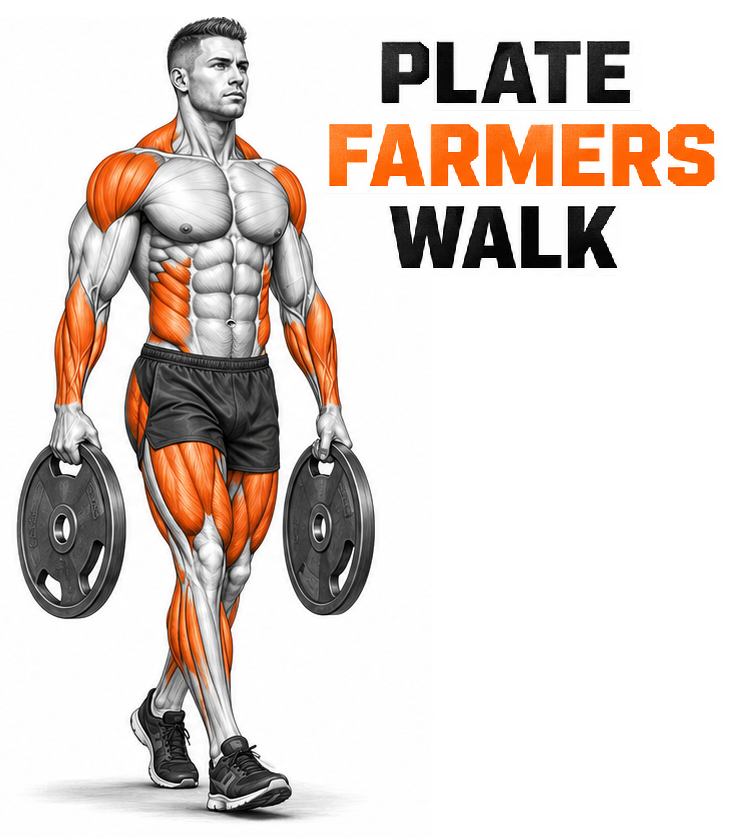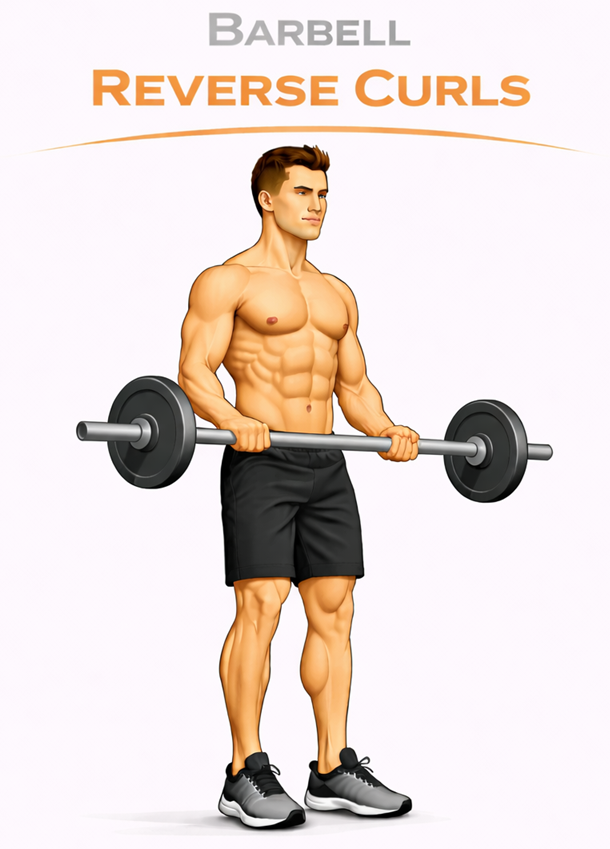
Barbell Reverse Curls
Overhand-grip barbell curl — shifts the work from the biceps to the brachioradialis and forearms while still loading the elbow flexors.
Level: Foundation
Primary: Forearms
Secondary: Biceps
Movement: Isolation
Tags: Pull
Type: Strength (Weight Lifting)
Equipment: Barbell
Sports: Baseball Wrestling
Target muscles
The brachioradialis of the forearm becomes the dominant muscle thanks to the pronated (overhand) grip — it works hardest when the forearm is in a neutral or slightly pronated position, exactly what this curl gives. The brachialis (which sits underneath the biceps) contributes meaningfully and is often underdeveloped in lifters who only do supinated curls. The biceps brachii participates but is at a mechanical disadvantage in pronation. The wrist extensors and the grip muscles work isometrically to hold the bar in the pronated position — which is why this lift quietly builds forearm size and grip strength.
How to perform
Setup
Stand tall with feet hip-width apart, holding the barbell with an overhand grip slightly wider than shoulder-width. Wrists straight — neither cocked back nor curled forward. Elbows pinned to the sides. Shoulders down and back. A slight knee bend keeps you stable.
Execution
Curl the bar up by flexing at the elbow, keeping the wrists straight and the upper arms stationary at your sides. The bar will come up to about chest height before the wrist mechanics make further range awkward. Pause briefly at peak contraction. Lower the bar over a count of two to three to the fully extended position; the eccentric is where most of the muscle-building work lives, especially for the brachioradialis. Don't swing the body to assist; the load should be light enough that strict form is the rule, not the exception.
Common mistakes
- Loading it as heavy as a regular curl. Reverse curls are typically 60-70% of supinated curl loads. Trying to match your standard curl number guarantees swing and wrist strain.
- Cocking the wrists back to "include" the forearms more. The wrists stay straight; the forearms get worked through their natural curl mechanics, not by twisting.
- Swinging the torso to launch the bar. If you can't curl it strict, drop the load.
- Using a thick bar without grip strength to match. The pronated grip is harder to maintain than supinated; a thick bar makes it harder still.
- Skipping the eccentric. Two- to three-second descent on every rep, every set.
Progressions and regressions
Regress to dumbbell reverse curls (one arm at a time, easier to dose with strict form). EZ-bar reverse curls are kinder to the wrists than a straight Olympic bar. To progress, work hammer curls (neutral grip — splits the difference between reverse and supinated), pause reps at peak contraction, or load with a fat bar or thick-grip attachment for a serious forearm and grip stimulus.
Programming notes
Accessory work, not main lifts. 2-3 sets of 8-12 reps after the main pulling work or at the end of an arm-day session. Once or twice a week. Pairs well with hammer curls and grip-specific work for a complete forearm and elbow-flexor stimulus. Don't program right before a session that demands grip strength (heavy deadlifts, pull-up volume) — fried forearms leak into your main lifts the next day.