Barbell Squat Press
Front squat into an overhead press in one motion — also called a thruster, this is a full-body power-endurance staple.
Level: Advanced
Primary: Forearms
Movement: Compound
Tags: Push
Type: Anaerobic Intervals (HIIT / Bootcamp / Circuit) Strength (Weight Lifting)
Equipment: Barbell
Sports: Basketball Football Rugby Track and Field Volleyball
Target muscles
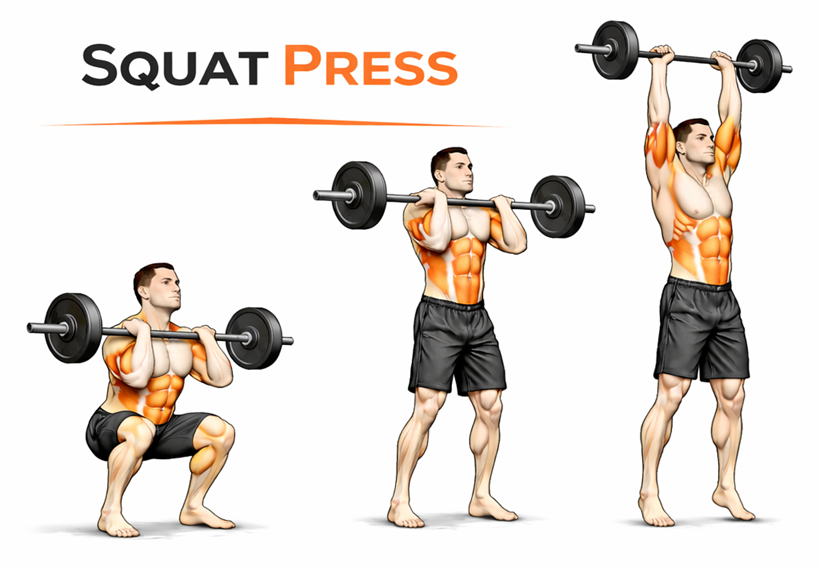
The quadriceps, glutes, and hamstrings drive the squat phase. The deltoids and triceps drive the press phase. The trunk braces continuously to transfer force from the legs through to the bar overhead. The lats and upper back stabilize the bar in the front rack and at the overhead lockout. As a single combined movement, the squat-press is one of the most cardiovascularly demanding lifts in the gym — heart rate spikes within a few reps because so much muscle is firing.
How to perform
Setup
Set the bar in the rack at upper-chest height. Take a clean front-rack grip just outside shoulder-width. Pull the bar onto the front shoulders, elbows high. Unrack and step back into a squat stance — feet shoulder-width apart, toes slightly out. Big breath, brace.
Execution
Squat down to depth (hip crease below the top of the knee) with the torso tall and the elbows high. As you drive out of the bottom, transfer the leg drive directly into a press — the upward momentum from the squat launches the bar overhead. Push the head forward through the window as the bar passes the face. Lock out with the bar overhead. Lower the bar to the front rack and immediately descend into the next squat. Continuous rhythm; the squat and press flow as one movement, not two.
Common mistakes
- Pausing in the front rack between the squat and the press. The leg drive should connect directly to the press; pausing loses the momentum.
- Cutting squat depth as the set wears on. Depth first; if you can't hit depth, the load is too heavy for the rep count.
- Pressing in a soft trunk. Brace before each squat-press cycle; without the brace, force from the legs doesn't reach the bar.
- Treating it as the same load as your front squat. The press caps the working weight — usually 60-70% of front squat max.
- Long unbroken sets at high loads with breakdown form. Short sets, clean reps, or accept that the working weight is too heavy.
Progressions and regressions
Regress to the dumbbell or kettlebell thruster (more forgiving and easier to dose by weight). Build the components separately: front squat for legs and trunk, push press for the launch mechanics. To progress, work clusters (3 reps + short rest + 3 reps + short rest, all on the same clock), heavy doubles, or programmed Fran-style CrossFit benchmarks (21-15-9 reps with pull-ups) for power-endurance.
Programming notes
Excellent power-endurance lift. 3-4 sets of 6-10 reps at moderate loads, or used in metabolic conditioning circuits (Tabata 20 seconds work / 10 seconds rest, EMOM formats). Don't program max-effort thrusters and heavy squats in the same week without recovery built in — the cumulative leg fatigue catches up fast. As a finisher, one or two all-out sets of 10-20 reps will spike heart rate dramatically.