Resistance Band Upright Row
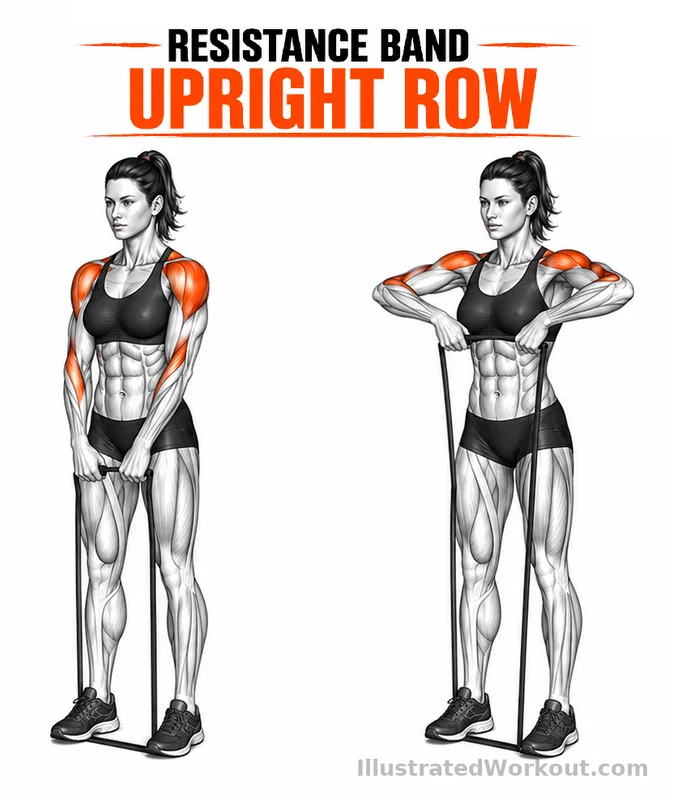
A vertical band pull that draws the hands up the body to the chest, building the side deltoids and upper trapezius together.
Want a resistance band shoulder workout?
Our wizard builds one around your time, goal, and equipment in about two minutes. Free — no signup needed.
Make Me a Workout → Just did it? Track your setsA vertical band pull that draws the hands up the body to the chest, building the side deltoids and upper trapezius together.
Level: Foundation
Primary: Shoulder Traps
Secondary: Biceps
Movement: Compound
Tags: Pull
Type: Strength (Weight Lifting)
Equipment: Resistance Band
Target muscles
Two muscle groups share this pull: the lateral and anterior deltoids raise the upper arms out and up, while the upper trapezius elevates the shoulder blades to lift the hands high. The biceps and forearms flex the elbows and grip the band, and the supraspinatus of the cuff assists early in the pull. Because the band's tension climbs as you rise, the delts and traps meet their hardest resistance near the top of the row, where the shoulders are fully elevated.
How to perform
Setup
Stand on the middle of the band with feet hip-width and hold an end in each hand in front of the thighs, palms toward the body and hands roughly shoulder-width apart. Stand tall with a light pre-tension in the band, shoulders down and core braced. Keep the knees soft and the chest lifted.
Execution
Pull the hands straight up the front of the body toward the chest, leading with the elbows so they stay above the wrists and flare out to the sides. Rise until the hands reach roughly chest height and the elbows are level with or just below the shoulders. Squeeze the traps and side delts at the top, then lower slowly, resisting the snap-back over two to three seconds. Keep the band close to the body and the torso upright — do not swing or lean back. Exhale on the way up, inhale on the way down.
Common mistakes
- Pulling the elbows above the shoulders, which pinches the shoulder joint and can aggravate the cuff.
- Swinging the torso or bouncing at the hips to heave the band upward.
- Letting the hands drift out away from the body instead of tracking straight up the front.
- Dropping the band fast at the top rather than controlling the eccentric against its pull.
Progressions and regressions
Regress by widening the stance to lower band tension, using a lighter band, or keeping the pull to just above the waist to protect the shoulder. Progress with a heavier band, both feet planted on it for more tension, or a pause at chest height. A wide-grip version biases the side delts and is generally kinder to the shoulder than a narrow grip.
Programming notes
Train it for ten to fifteen reps across two or three sets on shoulder or pull days, after heavier presses and rows. It builds shoulder width and trap thickness with one movement. Keep the elbows below shoulder height and stop short if the joint pinches — anyone with a history of shoulder impingement should favour lateral raises and a wide, shallow pull instead.