Punching Bag Karate Kid Kicks
A novelty front kick launched from a raised crane stance, blending single-leg balance with a springy hip snap into a heart-pumping conditioning drill.
Want a punching bag conditioning workout?
Our wizard builds one around your time, goal, and equipment in about two minutes. Free — no signup needed.
Make Me a Workout → Just did it? Track your setsA novelty front kick launched from a raised crane stance, blending single-leg balance with a springy hip snap into a heart-pumping conditioning drill.
Level: Foundation
Primary: Cardio
Secondary: Abs Calves Glutes Quads
Movement: Compound
Tags: Explosive
Type: Aerobic (Cardio) Anaerobic Intervals (HIIT / Bootcamp / Circuit)
Equipment: Punching Bag
Target muscles
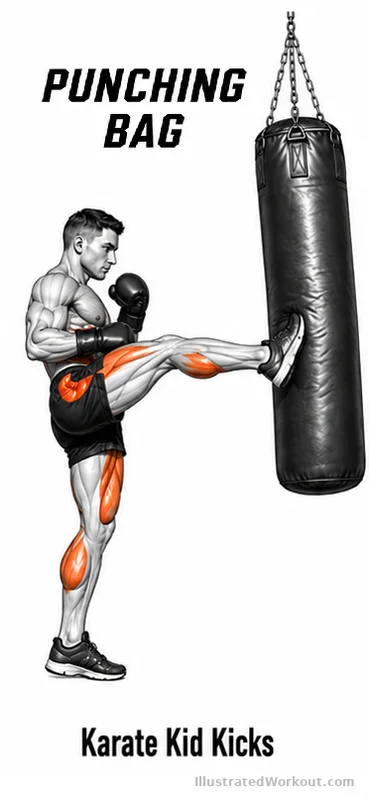
Balancing on one leg keeps the standing glute, calf and foot in constant stabilising work while the ankle makes tiny corrections. The kicking leg drives from the hip flexors and quadriceps to snap the knee open, and the abs brace hard to hold the torso steady over a narrow base. Because each rep asks for a fresh balance-and-fire cycle, the drill spikes the heart rate quickly and challenges coordination as much as strength.
How to perform
Setup
Stand an arm's length from the bag with hands up. Shift your weight onto one leg and lift the other knee high into a crane-style chamber, foot tucked and torso tall. Brace the abs and find your balance before launching, keeping the standing knee soft and the eyes on the target.
Execution
From the raised chamber, snap the kicking leg forward and extend the knee to strike the ball of the foot into the bag, driving the hip toward the target for reach. Recoil the leg straight back into the high chamber under control rather than dropping it, then rebalance and fire again. Keep the standing foot planted and the arms up for counterbalance and guard. Exhale on each strike and stay tall through the spine so the balance holds as fatigue builds. Work a set number of kicks on one side, then switch legs to train the other side evenly.
Common mistakes
- Rushing the launch before the balance is set, so the kick lands weak and the landing is sloppy.
- Dropping the knee low between reps instead of recoiling back to the high chamber.
- Leaning the torso far back to reach, which collapses balance over the standing leg.
- Kicking with a locked, stiff standing knee that jars the joint on each rep.
Progressions and regressions
Regress by holding the crane chamber for balance without kicking, then adding slow, light kicks with a hand on a wall for support. Progress by increasing speed, kicking higher on the bag, or alternating legs each rep for a tougher balance and cardio challenge. Adding a small hop on the standing leg turns it into a plyometric variation.
Programming notes
Program it as a playful conditioning and balance station, thirty to forty-five seconds per leg inside a bag circuit. It builds single-leg control and coordination that carry over to real kicking, but it is a novelty drill rather than a power kick, so treat it as accessory conditioning. Both sides train the same pattern, so give each leg equal work and stop if the standing ankle or knee feels unstable.