Mini Trampoline Toe Taps
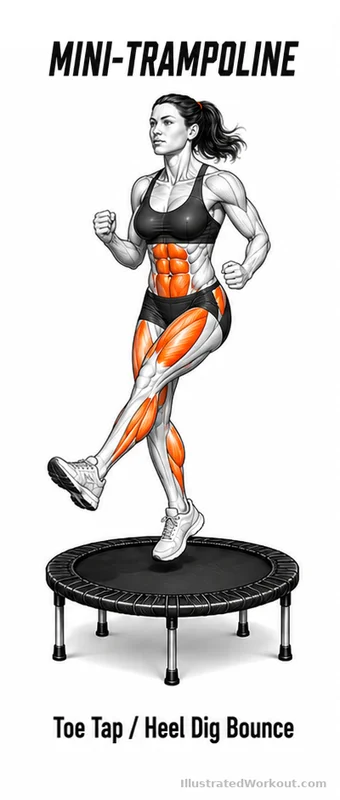
A gentle warm-up drill tapping the toes alternately onto the mat, lightly raising the heart rate and firing the shins and hip flexors.
Want a mini trampoline conditioning workout?
Our wizard builds one around your time, goal, and equipment in about two minutes. Free — no signup needed.
Make Me a Workout → Just did it? Track your setsA gentle warm-up drill tapping the toes alternately onto the mat, lightly raising the heart rate and firing the shins and hip flexors.
Level: Beginner
Primary: Cardio
Secondary: Calves Quads
Movement: Isolation
Type: Aerobic (Cardio) Light Activity
Equipment: Mini Trampoline
Target muscles
The hip flexors lift each foot to tap the toe forward while the tibialis anterior on the shin dorsiflexes the ankle, and the calves and quadriceps of the standing leg control the light bounce beneath. The core braces gently to keep the torso upright as the legs alternate. It is a low-intensity drill, so the demand is mild and aerobic, prized more for warming the ankles and hips than for building a hard sweat.
How to perform
Setup
Stand behind or beside the mat, or on it with a bounce, feet hip-width and knees soft. Bring the weight onto the balls of the feet and brace the trunk so the chest stays tall. Let the arms bend lightly in a running posture and fix the gaze forward to steady the balance.
Execution
Bounce lightly and tap the toes of one foot forward onto the mat, then switch quickly to tap the other, keeping the contacts soft and rhythmic. Keep most of the weight on the standing leg and let the tapping foot touch lightly rather than stamp. Stay tall through the torso, letting the hip flexor lift each foot rather than leaning back. Keep an even, brisk alternation and breathe in an easy rhythm. The pace can stay gentle for a warm-up or quicken for a livelier tap, but the touches should always land light and controlled.
Common mistakes
- Stamping the tapping foot down hard instead of touching light and controlled.
- Leaning the torso back rather than lifting each foot with the hip flexor.
- Losing the rhythm so the two feet tap unevenly and the cadence stutters.
- Stiffening the standing knee so the underlying bounce jars instead of absorbing softly.
Progressions and regressions
Regress by slowing the tap to a deliberate one-foot-at-a-time touch, using a stability bar for balance. Progress by quickening the cadence, tapping the toes to the side or across the body, or raising the knee higher before each tap to blend it toward high knees for a livelier drill.
Programming notes
Use it early as a warm-up to switch on the shins, ankles and hip flexors before harder rebounding, thirty to sixty seconds is plenty. It also works as a light active-recovery station between tougher efforts. Because the intensity is deliberately low, it is not a standalone cardio session; keep it as a primer or a gentle reset within a broader rebounder routine.