Mini Trampoline Tuck Jumps
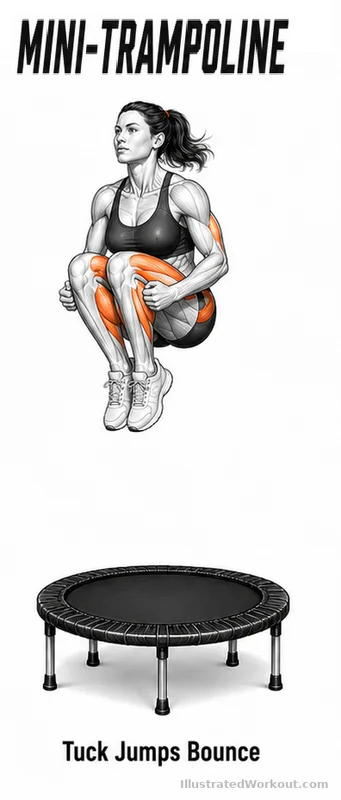
Explosive tucked jumps cushioned by the mat, driving the knees up toward the chest at the top of each rebound for a powerful conditioning hit.
Want a mini trampoline conditioning workout?
Our wizard builds one around your time, goal, and equipment in about two minutes. Free — no signup needed.
Make Me a Workout → Just did it? Track your setsExplosive tucked jumps cushioned by the mat, driving the knees up toward the chest at the top of each rebound for a powerful conditioning hit.
Level: Foundation
Primary: Cardio
Secondary: Abs Calves Quads
Movement: Compound
Tags: Explosive
Type: Anaerobic Intervals (HIIT / Bootcamp / Circuit) Plyometric
Equipment: Mini Trampoline
Target muscles
The quadriceps, glutes and calves generate the upward drive on each jump, while the hip flexors and rectus abdominis snap the knees up toward the chest at the peak. The core braces hard to control the tuck and reopen the body for landing, and the hamstrings help decelerate on the way down. This is a genuinely explosive effort, so it demands real power and drives the heart rate high, though the mat softens the landing impact more than a hard floor would.
How to perform
Setup
Stand over the centre of the mat with feet hip-width, knees soft and weight in the mid-foot. Brace the trunk firmly and set the chest tall, with the arms ready to swing up and down to help time the jump. Take a couple of small bounces first to load the mat's rebound.
Execution
Press hard into the mat to launch into a taller jump, and as you rise drive both knees up toward the chest into a quick tuck, swinging the arms to assist. Release the tuck and extend the legs to meet the mat with soft, controlled knees, immediately loading the next jump. Keep the torso upright and the core braced so the tuck does not fold you forward. Stay centred on the mat and land through the balls of the feet. Time each tuck at the top of the flight and keep every landing quiet and absorbed rather than crashing down.
Common mistakes
- Tucking the knees before the jump peaks, so the legs never fully leave under control.
- Landing stiff or off-balance because the legs did not extend in time from the tuck.
- Folding the chest forward into the tuck instead of holding a braced, upright torso.
- Drifting toward the frame, where a mistimed explosive landing is dangerous.
Progressions and regressions
Regress to a power bounce with a small knee drive rather than a full tuck, or a low straight bounce to build the rebound timing first. Progress by tucking higher and faster, stringing more consecutive jumps together, or shortening the ground contact between reps for a more reactive, plyometric stimulus.
Programming notes
Program it as a short, high-intensity plyometric station, ten to twenty quality jumps or fifteen to thirty seconds, with full recovery between bouts. Train it while fresh, early in a session, since power fades quickly with fatigue and sloppy landings raise injury risk. It is the most demanding bounce here, so build the power bounce and squat bounce first, and skip it if the knees or ankles are irritated.