Dumbbell Push Press
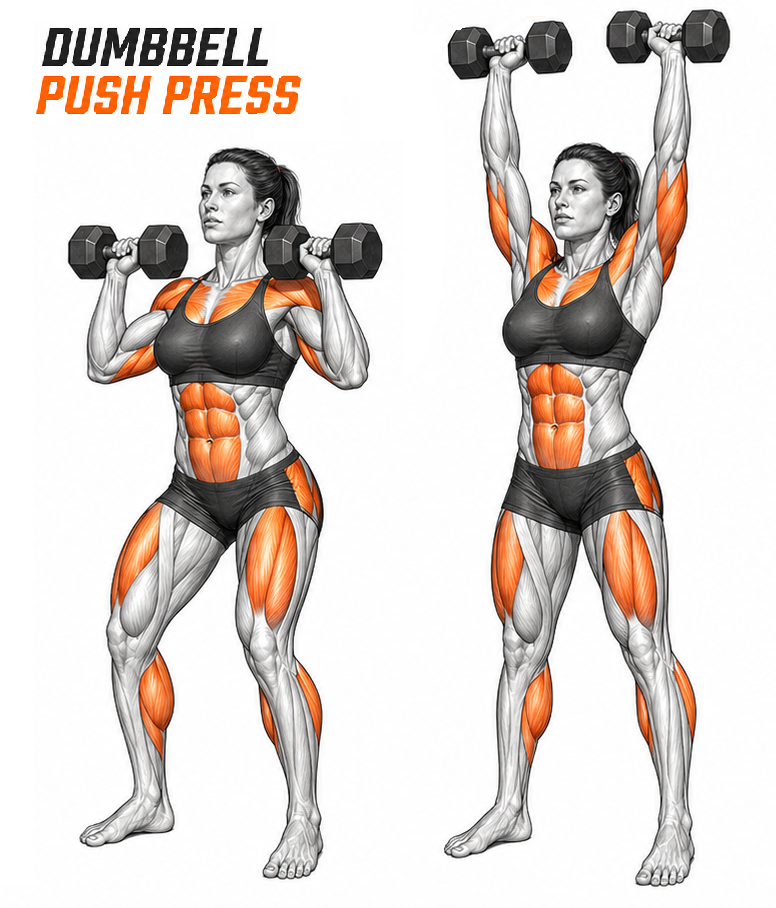
Dumbbell push press — dip-and-drive launches the dumbbells overhead, with the arms finishing the lockout.
Level: Intermediate
Primary: Shoulder
Secondary: Triceps
Movement: Compound
Tags: Explosive Push
Type: Anaerobic Intervals (HIIT / Bootcamp / Circuit) Strength (Weight Lifting)
Equipment: Dumbbell
Sports: Football Rugby Track and Field
Target muscles
The quadriceps and gluteus maximus drive the leg portion. The deltoids and triceps drive the lockout. The trunk braces hard to transfer leg force to the dumbbells. The serratus anterior stabilizes the scapulae through the overhead position. Versus the push jerk, the push press has no re-dip — the arms have to finish the press above the head, which makes it a different blend of power and strict pressing strength.
How to perform
Setup
Stand with dumbbells at the shoulders in front rack — elbows tucked, dumbbells resting on the deltoids. Feet hip-width apart. Trunk braced.
Execution
Dip straight down by bending the knees — torso stays vertical. Reverse the dip explosively, driving the dumbbells up with leg power. The arms continue the press through the sticking point, finishing lockout overhead with the dumbbells stacked over the shoulders. Lower the dumbbells back to the front rack under control.
Common mistakes
- Breaking at the hips. Torso stays vertical through the dip.
- Going too deep on the dip. Quarter-squat depth at most.
- Soft trunk during the drive. Brace before each rep.
- Pressing the dumbbells around the head rather than straight up. The path is vertical.
- Treating push-press loads the same as strict-press loads. Push-press allows 10-20% more weight than strict press.
Progressions and regressions
Regress to the strict shoulder press to build pure pressing strength before adding leg drive. The dip-and-drive without arms (just leg drive into a held overhead position) is a useful intermediate. To progress, work the push jerk (re-dip), or chain with strict presses in clusters.
Programming notes
Excellent for moving more weight overhead than a strict press allows. 3-5 sets of 3-6 reps, two times a week if pressing is a focus. Pair with strict pressing in the same program. As conditioning, push-press complexes (1 push press + 1 strict press) work well in moderate-load circuits.