Disc Slider Plate Pushes
Driving a loaded plate across the floor from a low athletic stance, a full-body grind that lights up the quads, glutes and shoulders.
Want a disc sliders full-body workout?
Our wizard builds one around your time, goal, and equipment in about two minutes. Free — no signup needed.
Make Me a Workout → Just did it? Track your setsDriving a loaded plate across the floor from a low athletic stance, a full-body grind that lights up the quads, glutes and shoulders.
Level: Intermediate
Primary: Full Body
Secondary: Glutes Quads Shoulder
Movement: Compound
Tags: Loaded Carry Push
Type: Anaerobic Intervals (HIIT / Bootcamp / Circuit) Functional Fitness (Obstacle & Hybrid)
Equipment: Disc Sliders
Target muscles
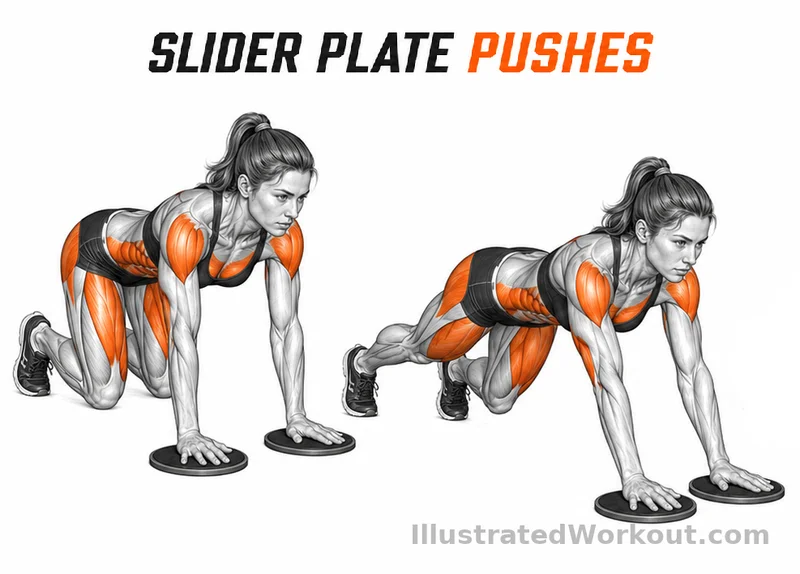
Every major muscle group contributes, though the quads and glutes provide the engine, driving the legs to push a loaded plate across the floor. The shoulders, chest and triceps transmit force through braced arms, the calves power each drive step, and the entire core stays locked so leg drive reaches the plate instead of leaking through a soft, bending trunk.
How to perform
Setup
Load a weight plate onto a slider or set it on a smooth floor, and take a staggered athletic stance behind it with hands pressed onto the plate or a low handle. Hinge the hips back, flatten the back, and set the arms firm. Brace the abs and load the legs so the first push comes from the hips, not the shoulders.
Execution
Drive through the balls of the feet and extend the hips and knees to push the plate forward, taking short, powerful steps as it glides. Keep the back flat and the arms locked so the whole body moves as one unit behind the load. Maintain a low, forward-leaning angle and keep the core braced so the hips do not pop up ahead of the shoulders. Push for a set distance or time, breathing in sharp bursts with each drive. Reset the stance if the hips rise or the back rounds, then continue.
Common mistakes
- Letting the hips shoot up so the push becomes an upper-body shove instead of a leg drive.
- Rounding the back under the forward lean, which strains the spine and leaks force.
- Standing too upright, which shortens each step and kills the horizontal drive.
- Pushing with bent, soft arms so force is lost before it reaches the plate.
Progressions and regressions
Regress by using a lighter plate or a shorter distance, or by pushing from a higher hand position that keeps the torso more upright. Progress by adding weight, extending the distance, or shortening the rest between pushes for a conditioning effect. Alternating heavy short pushes with light fast ones builds both strength and speed, and a low sled handle raises the difficulty further.
Programming notes
Program it as a power-and-conditioning piece, distances of ten to twenty metres or bouts of twenty to thirty seconds for several rounds. It fits finishers, strongman-style circuits and team conditioning where leg drive and full-body output are the goal. Keep the back flat and the load manageable; it is fatiguing, so place it late in a session and avoid it when the low back is already tired from heavy hinging.