Disc Slider Curtsy Lunge
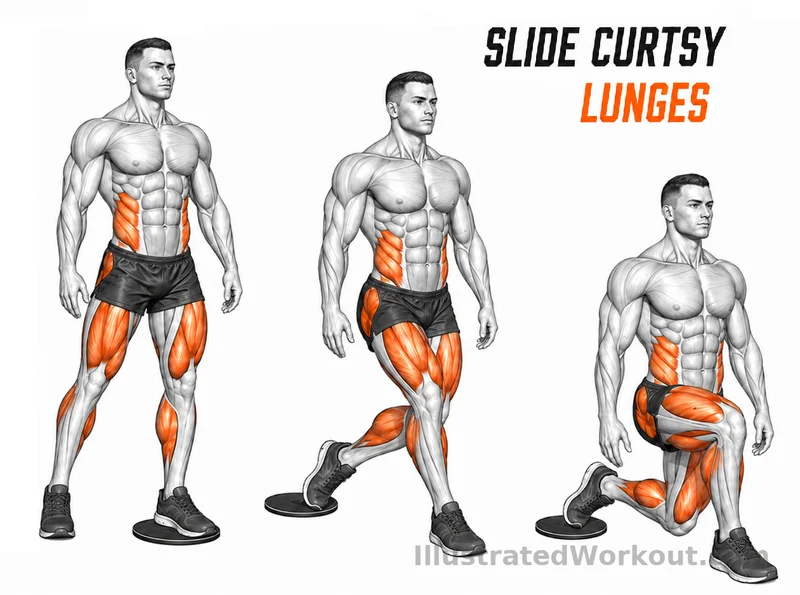
One foot slides back and across behind the body into a deep curtsy, loading the glutes and quads through a hip-stabilising single-leg pattern.
Want a disc sliders glute workout?
Our wizard builds one around your time, goal, and equipment in about two minutes. Free — no signup needed.
Make Me a Workout → Just did it? Track your setsOne foot slides back and across behind the body into a deep curtsy, loading the glutes and quads through a hip-stabilising single-leg pattern.
Level: Advanced
Primary: Glutes Quads
Secondary: Abductors Hamstrings
Movement: Compound
Tags: Lunge Unilateral
Type: Functional Fitness (Obstacle & Hybrid) Strength (Weight Lifting)
Equipment: Disc Sliders
Target muscles
The front-leg quads and glutes carry the load as you sink and stand, while the gluteus medius and the deep hip rotators fire hard to control the crossing leg and keep the pelvis level. The adductors of the sliding leg lengthen and pull as it glides back and across, and the hamstrings assist the hip extension out of the bottom. Because the base is narrow and the slide adds instability, the whole hip complex works to stay balanced.
How to perform
Setup
Stand tall with a slider under one foot and most of your weight on the opposite standing leg. Set the hips square, brace the trunk and soften the standing knee. Fix your eyes ahead and find a stable, balanced position over the working leg before you begin the slide.
Execution
Glide the slider foot back and diagonally behind the standing leg, bending the front knee to sink into a curtsy until the back knee hovers near the floor. Keep the front knee tracking over the toes and the chest tall, then drive through the front heel and pull the sliding foot back to the start under control. Move slowly so the slider never gets away from you, and keep the pelvis level rather than letting it drop toward the crossing side. Complete the reps on one leg before switching.
Common mistakes
- Letting the front knee cave inward instead of driving it out to track over the second toe.
- Dropping the hip on the crossing side rather than keeping the pelvis level and controlled.
- Leaning the torso forward and turning it into a good-morning instead of an upright curtsy.
- Letting the slider shoot out fast so the descent loses tension and balance.
Progressions and regressions
Regress to a stationary bodyweight curtsy lunge without the slider, or shorten the range while balance improves. Holding a rail or wall for light support also helps early on. Progress by holding dumbbells or a goblet weight, pausing at the bottom of each rep, or slowing the eccentric to increase time under tension on the working glute and quad.
Programming notes
Use it as a single-leg strength and hip-stability piece, three sets of eight to twelve per leg. It fits lower-body days as an accessory after squats or hinges, or in a glute-focused block. The crossing pattern stresses the knee and hip, so warm up the hips first and keep the load moderate. Skip it or regress if the knee tracking cannot stay clean, since a caving knee under a sliding load is a real injury risk.