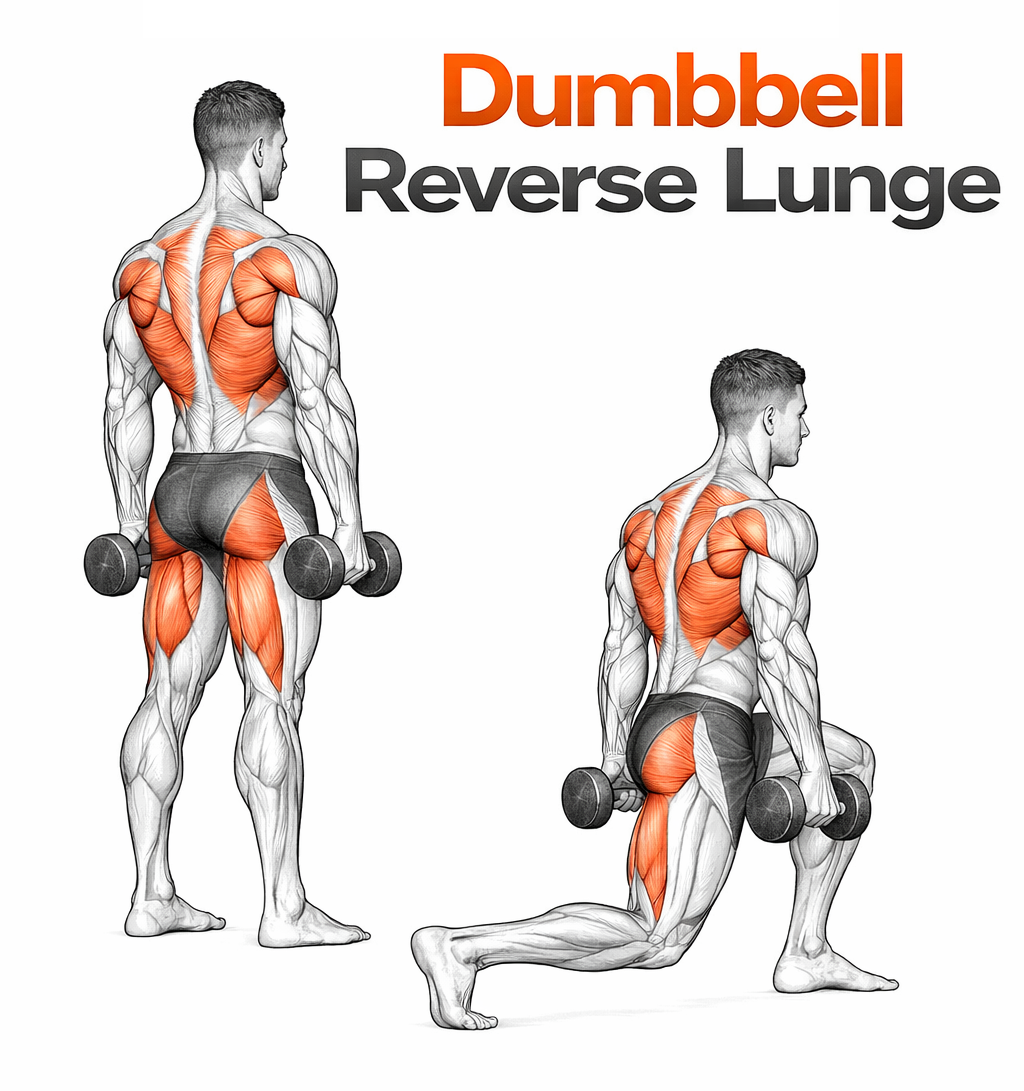
Dumbbell Reverse Lunge
Backward-stepping dumbbell lunge — gentler on the knees than forward lunges, loaded by dumbbells at the sides.
Level: Intermediate
Primary: Quads
Secondary: Glutes Hamstrings
Movement: Compound
Tags: Lunge Unilateral
Type: Strength (Weight Lifting)
Equipment: Dumbbell
Sports: Basketball Football Lacrosse Soccer Tennis
Target muscles
The quadriceps and gluteus maximus of the front (planted) leg drive the lockout. The gluteus medius stabilizes the hip. The hamstrings co-contract. The hip flexors of the back leg are stretched on each descent. The trunk braces against the asymmetric load. Versus a forward lunge, the reverse-step has less anterior knee shear because the descent is initiated by the back-stepping leg rather than the front knee.
How to perform
Setup
Stand with feet together, a dumbbell in each hand at the sides. Trunk braced, chest up.
Execution
Step one foot straight back about two to three feet. Lower the back knee toward the floor by bending both knees — the front knee tracks over the second toe, the back knee descends until it's an inch or two off the floor. Keep the torso upright. Drive through the front foot to push back to the starting position. Plant both feet, reset. Step back with the other leg. Alternate or complete one side at a time.
Common mistakes
- Pushing off the back foot. The front leg does the work.
- Front knee shooting past the toes. Lengthen the back step.
- Torso pitching forward. Stay tall.
- Step too long, putting the front quad in a stretched position. Two to three feet is the working range.
- Same load both sides without checking. Use the weak side's number.
Progressions and regressions
Regress to bodyweight reverse lunges until the pattern is clean. To progress, increase the dumbbell load, work the rear-foot-elevated reverse lunge (back foot on a bench — basically a Bulgarian split squat), or move to the barbell on the back for greater loading.
Programming notes
Excellent primary or secondary single-leg lift. 3-4 sets of 8-12 reps per side. Two times a week. The knee-friendly load profile makes this useful for athletes managing patellar tendon fatigue. Pair with forward lunges and step-ups for variety.