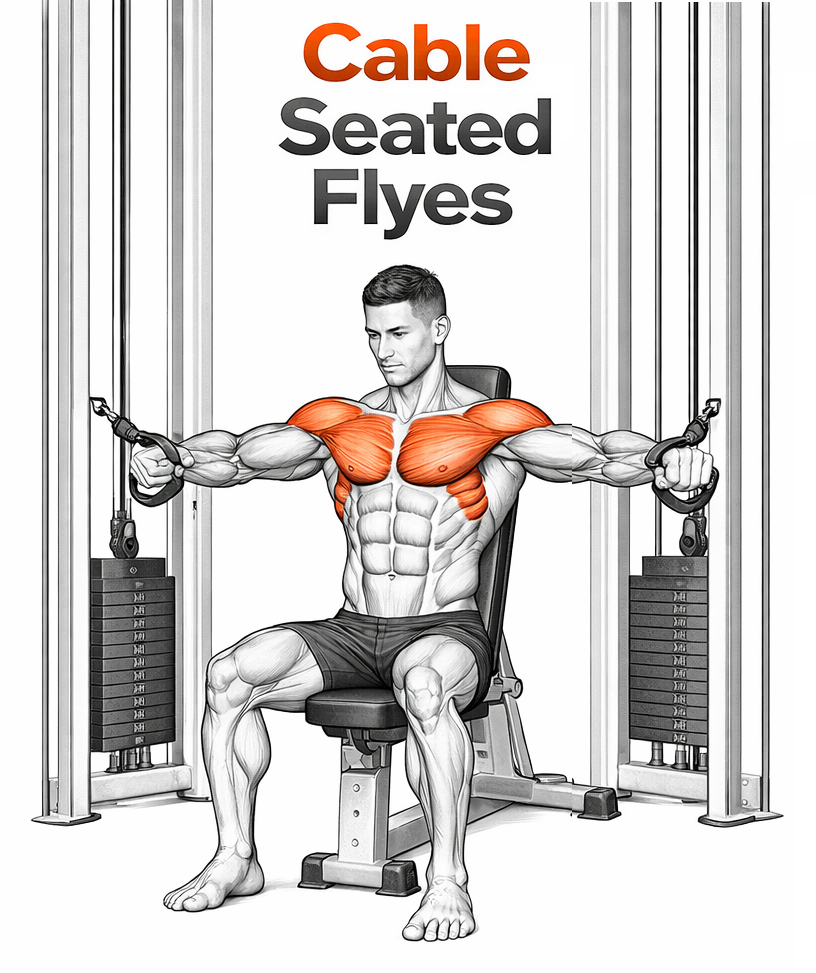
Cable Seated Flyes
Seated cable fly between two cable stacks — chest isolation through a long arc with constant tension a dumbbell fly can't match.
Level: Beginner
Primary: Chest
Movement: Isolation
Tags: Push
Type: Strength (Weight Lifting)
Equipment: Cable
Sports: Football Swimming
Target muscles
The pectoralis major is the prime mover, working through horizontal shoulder adduction across the full range. The anterior deltoid contributes lightly. The biceps grip the handles and stabilize the elbows but should not drive the movement. The serratus anterior holds the scapulae against the ribs. The cable's pull through the entire range — including the stretched position at the bottom — provides loading where a dumbbell fly loses tension. That stretched-position loading is much of what makes cable flyes more effective for chest hypertrophy than dumbbell flyes at equivalent loads.
How to perform
Setup
Sit on a bench between two cable stacks set at chest height. Grip the handles with a neutral grip (palms facing each other), arms extended out to the sides at chest height in a slight elbow bend. The starting position is the stretched position — arms wide, chest open, slight stretch felt across the pec.
Execution
With the slight elbow bend maintained throughout, bring the hands together in front of the chest in a hugging arc — like wrapping arms around a barrel. The hands meet or nearly meet at the contracted position. Squeeze the chest hard at peak contraction for a one-second hold. Reverse the arc slowly through the same path back to the stretched starting position. The elbow bend stays consistent; if the elbows bend further during the rep, the exercise becomes a partial press rather than a fly.
Common mistakes
- Bending the elbows more during the rep, which converts the fly into a partial press.
- Going too heavy. The chest is loaded through a long lever; light strict reps are the right approach.
- Not letting the arms travel fully back at the stretched position. The stretch is most of the value.
- Hunching the shoulders forward at the contracted position. Keep the chest up; the contraction should come from the pecs, not the shoulders rolling.
- Cutting the top contraction short. Hold the hands-together position for a real squeeze.
Progressions and regressions
Regress to dumbbell flyes (lying on a flat bench) until the pattern feels natural. Pec-deck machine flyes provide a similar constant-tension feel with less stability demand. To progress, work single-arm cable flyes (great for working out side-to-side imbalances), or alternate cable angles (high cable for downward flyes, low cable for upward flyes) to hit different chest regions in the same session.
Programming notes
Excellent chest isolation after the main pressing volume. 3-4 sets of 12-15 reps, once or twice a week. The flyes burn the chest in a way pressing doesn't — pair them with bench press and incline press for complete chest development. As a finisher with a drop set, this is among the most effective chest pumps available.