Barbell Bench Press
The classic horizontal press — barbell from chest to lockout on a flat bench, the benchmark lift for upper-body pushing strength.
Level: Intermediate
Primary: Chest
Secondary: Shoulder Triceps
Movement: Compound
Tags: Primary Lift Push
Type: Strength (Weight Lifting)
Equipment: Barbell
Sports: Football Rugby
Target muscles
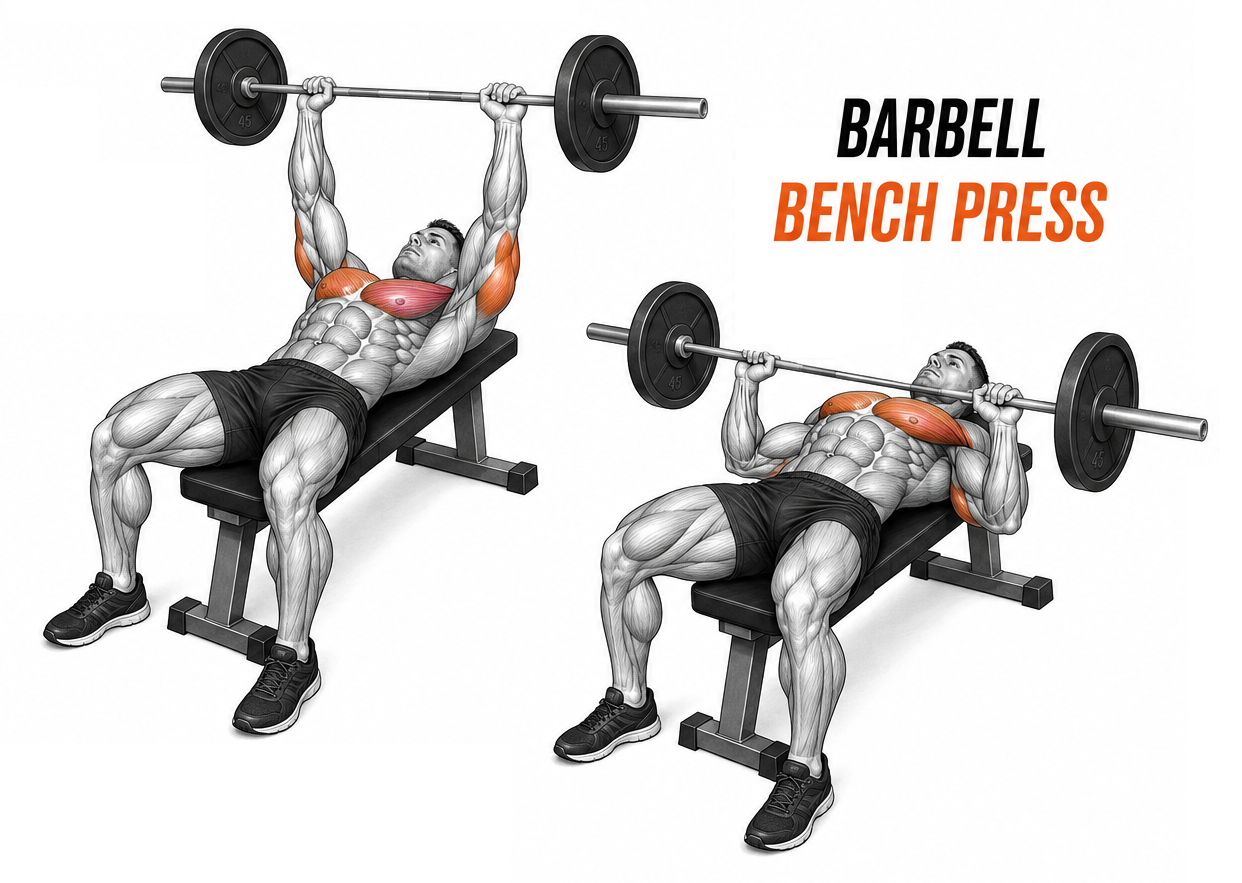
The pectoralis major (sternal head most prominently) drives shoulder horizontal adduction, the anterior deltoid contributes to shoulder flexion, and the triceps brachii lock out the elbow. The serratus anterior holds the scapula stable against the ribcage; the rotator cuff muscles work to stabilize the humeral head as the bar travels. With your feet planted and a slight arch through the upper back, the lats and lower traps create the platform — the bench press is far more of a full-body lift than its appearance suggests.
How to perform
Setup
Lie down so your eyes sit directly under the bar. Plant the feet flat on the floor (or on the bench's leg supports if you're short — never let them dangle). Pull your shoulder blades back and down, creating a slight arch through the upper back; ribcage proud, not collapsed. Grip the bar slightly wider than shoulder-width so the forearms come up vertical at the bottom of the rep. Wrists straight and stacked over the elbows. Take a big breath, brace the trunk, unrack with locked elbows, and pull the bar over the shoulders.
Execution
Lower the bar to the lower chest with control — about three to four seconds for a working set — keeping the elbows tucked at roughly a 45-degree angle to the torso (not flared at 90). Touch the chest, briefly, with the bar; no bouncing. Drive the bar back up and slightly back toward the rack so the path is a shallow J. Lock out and reset the brace before the next rep. Exhale near the top of the press, inhale at lockout. Keep the feet driving into the floor through the entire set — you'll lose ten percent of your strength the moment your legs go limp.
Common mistakes
- Flaring the elbows out to 90 degrees — wrecks shoulders over time. Tuck them to about 45.
- Bouncing the bar off the chest. You're cheating yourself out of the hardest part of the rep and risking ribs.
- Hips coming off the bench on heavy reps. If you can't press it with hips down, the weight is too heavy.
- Pressing in a perfectly vertical line. The bar should travel back toward the face slightly through the press, not straight up.
- Skipping a spotter or safety pins on max attempts. The bench press is the most common cause of serious gym injuries — non-negotiable on heavy sets.
Progressions and regressions
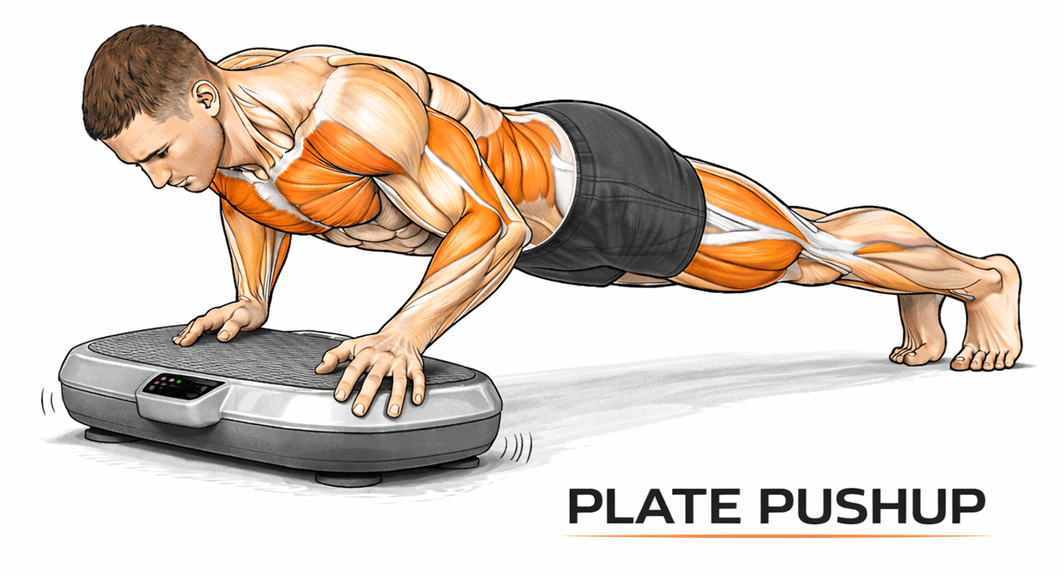
Regress to push-ups (with hands on a bench if needed), dumbbell bench press, or a Smith machine bench until the press groove is clean. From there, work up the bar with empty-bar technique reps before adding meaningful load. To progress beyond linear gains, cycle in pause bench (1-3 second pause at the chest), close-grip bench (more triceps), spoto press (1 inch off the chest), and incline variations. The press handles tonnage well — most lifters benefit from two bench days per week, one heavy and one volume-focused.
Programming notes
For strength: 3-5 sets of 3-5 reps at 80-90% 1RM, twice per week with at least 48 hours between sessions. For hypertrophy: 3-4 sets of 6-12 reps. Always pair pressing volume with rowing volume in equal or greater amounts (rows, face pulls, band pull-aparts) — without rear-delt and upper-back work to balance, the shoulders eventually rebel. If your bench is stalling, the answer is usually more lat and upper-back strength rather than more bench frequency.