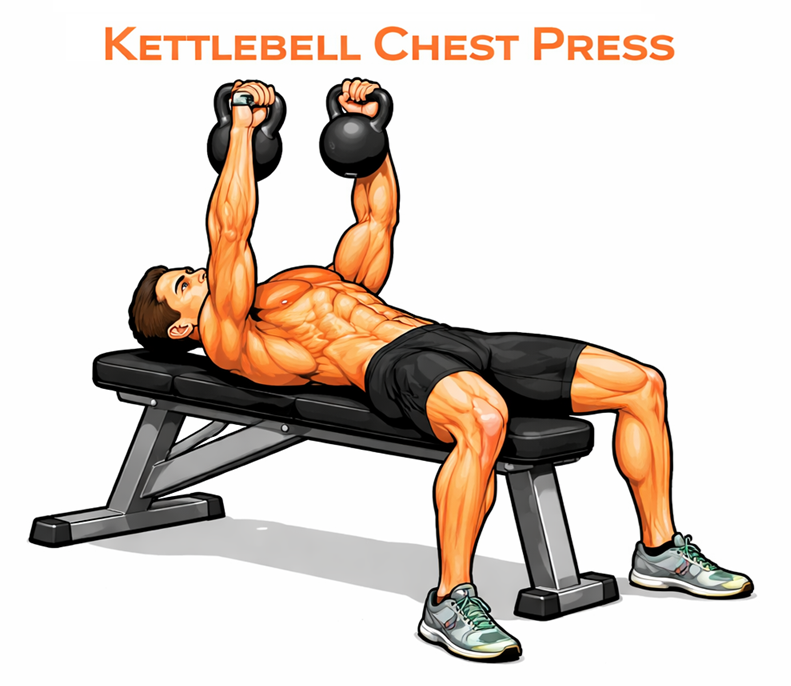
Kettlebell Chest Press
Lying kettlebell chest press with the bells resting on the back of the forearms — challenges the wrists and shoulders differently than dumbbells.
Level: Intermediate
Primary: Chest
Secondary: Shoulder Triceps
Movement: Compound
Tags: Push
Type: Strength (Weight Lifting)
Equipment: Kettlebell
Sports: Football Rugby
Target muscles
The pectoralis major drives shoulder horizontal adduction. The triceps lock out the elbows. The anterior deltoid contributes. The trunk braces. The wrists work hard to keep the kettlebells stable on the forearms — this is the unique demand of the kettlebell chest press versus a dumbbell version.
How to perform
Setup
Lie on your back on a flat surface holding a kettlebell in each hand with the bells resting on the back of the forearms, elbows bent at 90 degrees. Wrists stacked over elbows. Trunk braced.
Execution
Press the kettlebells straight up over the chest until the arms are fully extended. The bells stay balanced on the back of the forearms throughout. Lower under control back to the start. Keep the wrists rigid.
Common mistakes
- Letting the wrists collapse under the bell weight.
- Flaring the elbows wide.
- Dropping the kettlebells. The wrist control is non-negotiable.
- Going too heavy. Wrist stability caps the load.
- Cutting the range.
Progressions and regressions
Regress to dumbbell chest press until the wrist position is comfortable. To progress, work pause kettlebell press (2-second pause at the chest), or single-arm kettlebell press for unilateral focus.
Programming notes
Useful chest variation. 3-4 sets of 8-12 reps, twice a week. The wrist demand makes this less loadable than dumbbell bench but builds wrist stability.