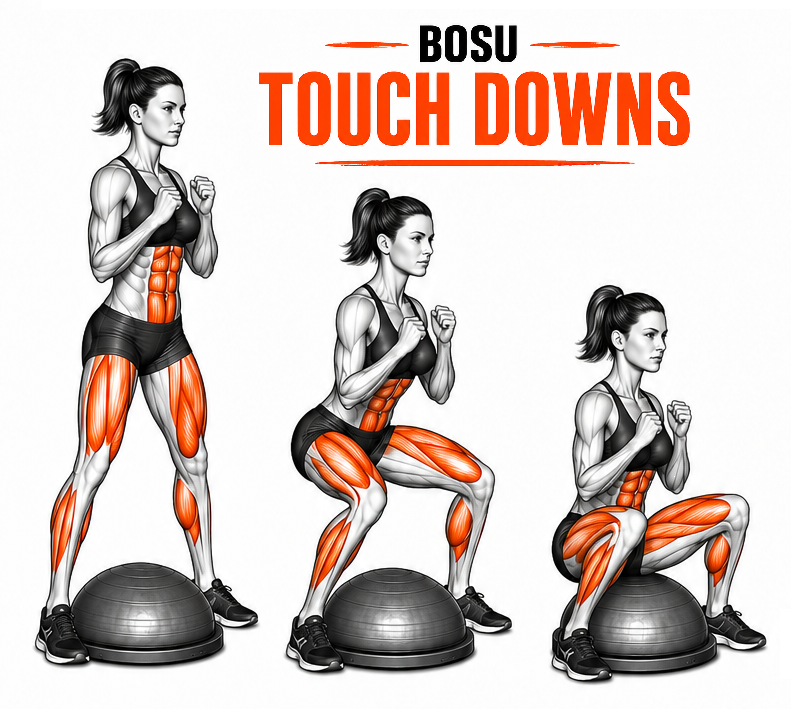
BOSU Touch Downs
A single-leg reach-and-touch on the BOSU that builds hip strength, balance and control through a hinge-squat pattern.
Level: Foundation
Primary: Glutes
Secondary: Hamstrings Quads
Movement: Compound
Tags: Balance / Stability Unilateral
Type: Functional Fitness (Obstacle & Hybrid) Strength (Weight Lifting)
Equipment: Balance Trainer
Target muscles
The gluteus maximus and hamstrings of the standing leg control the descent and drive the return, while the gluteus medius works hard to keep the pelvis level on one leg. The quadriceps assist the knee bend, and the foot and ankle stabilisers fire constantly to manage the unstable dome underfoot.
How to perform
Setup
Balance on one foot on top of the BOSU dome, the other leg lifted slightly. Stand tall with a soft knee and your core braced.
Execution
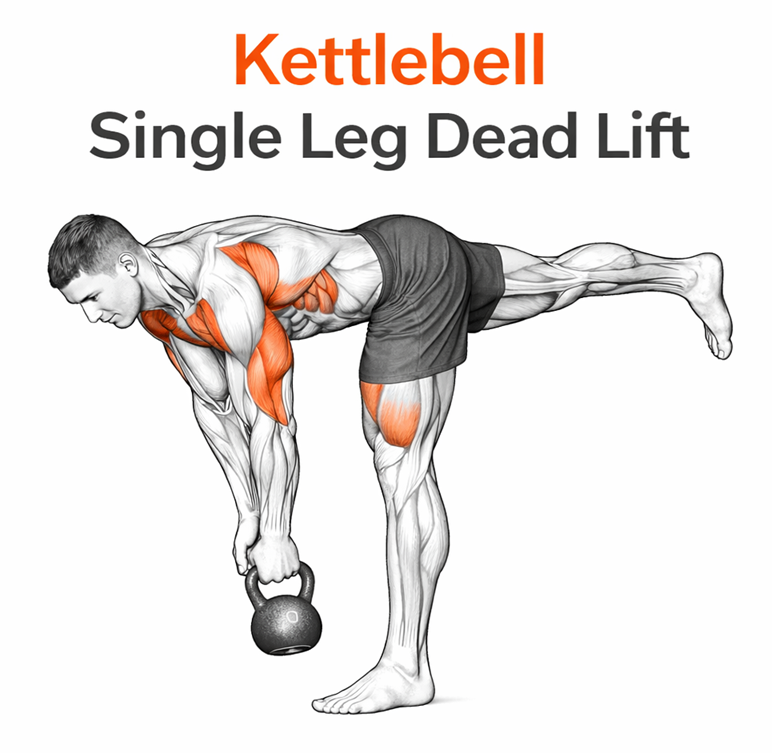
Hinge at the hip and bend the standing knee to lower your free hand toward the floor in front of or beside the dome, reaching under control. Keep your hips relatively square and your back flat. Touch down lightly, then drive through the standing leg's heel and squeeze the glute to return to tall and balanced. Complete the set on one leg before switching. Move slowly — this is a balance and control drill first, a strength drill second.
Common mistakes
- Rounding the back to reach the floor instead of hinging and bending the knee.
- Letting the standing knee cave inward as you lower.
- Dropping the hip of the free leg so the pelvis tilts and the glute medius switches off.
- Using momentum to bob up and down rather than controlling each rep.
Progressions and regressions
Regress by performing the touch-down on the floor or holding a support until balance improves. Progress by reaching further, holding a light weight in the reaching hand, or pausing at the bottom. Touching to multiple points — front, then diagonal — adds a multi-directional challenge.
Programming notes
Use it as single-leg accessory or rehab-style balance work, 2-3 sets of 8-12 per leg. It's excellent prehab for the knees and ankles and exposes left-right asymmetries. Slot it into a warm-up, on a lower-body day, or as a low-fatigue balance station in a circuit.