Cable Kettlebell Pulls
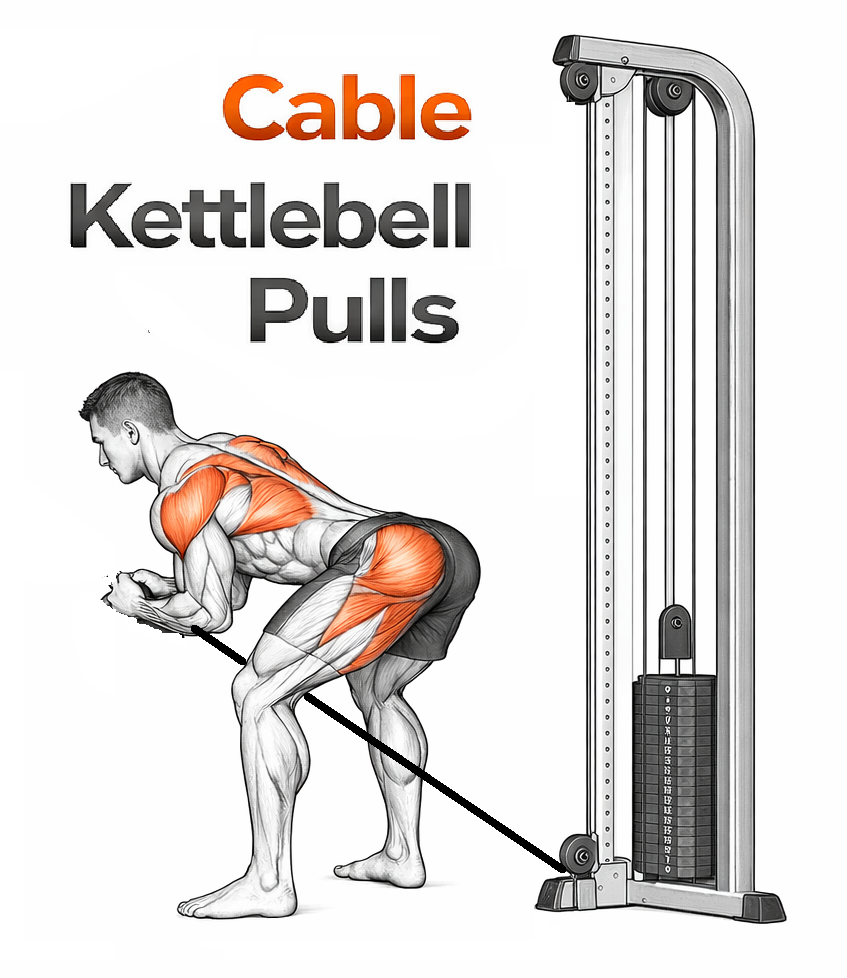
Cable swing with a kettlebell handle — a hip-hinge power movement with the constant tension of a cable instead of kettlebell ballistics.
Level: Foundation
Primary: Glutes
Movement: Compound
Type: Strength (Weight Lifting)
Equipment: Cable
Sports: Football Swimming
Target muscles
The gluteus maximus and hamstrings drive the hip extension. The spinal erectors hold the spine neutral against the load. The lats keep the cable handle close to the body and pack the shoulders. The trunk braces against the cable's pull. Unlike a kettlebell swing — where the load is most resistant at the bottom and floats at the top — the cable maintains tension throughout the full range. That changes the loading profile: more time under tension, less of a true ballistic stimulus.
How to perform
Setup
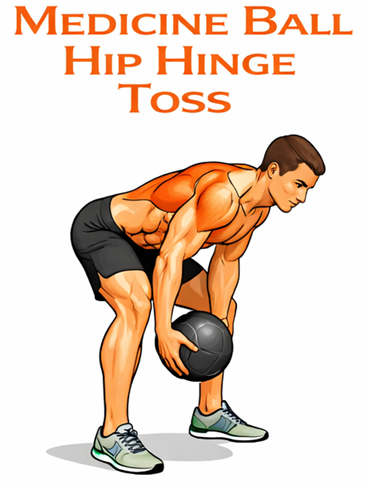
Attach a kettlebell handle or a similar single-grip attachment to the lowest cable. Stand facing the machine about three to four feet back. Grip the handle with both hands. Hinge at the hips with a slight knee bend, bringing the handle down between the legs to belt level. Pack the lats, brace the trunk. Feet shoulder-width.
Execution
Drive the hips forward explosively, swinging the cable handle up to chest or shoulder height. The arms stay nearly straight; the hips do the work. At the top, the body is fully extended — glutes squeezed hard, no lean back. Let the handle pull you back into the hinge under control. The cable's constant pull will try to drag you forward; the trunk holds position. Continuous rhythm rep to rep.
Common mistakes
- Using the arms to lift the handle. The lift is hip-driven; arms are connections.
- Squatting instead of hinging. The hips move back, not down — knees bend slightly, but the work is hip-driven.
- Hyperextending the lower back at the top. Hips extend, glutes squeeze — the lumbar stays neutral.
- Loading too heavy. The cable's resistance through the full range makes this feel heavier than a kettlebell swing at equivalent weight.
- Cutting the bottom range to make the rep easier. Hinge fully back; the bottom stretch is where the glutes load.
Progressions and regressions
Regress to a kettlebell deadlift (no swing) to groove the hinge pattern, then to a kettlebell swing if equipment is available. The cable Romanian deadlift is a related hinge variation with similar mechanics. To progress, work single-arm cable swings (greater anti-rotation demand), or load up for serious power-endurance work in conditioning intervals.
Programming notes
Excellent posterior chain conditioning or accessory work. 3-4 sets of 10-15 reps, or 30-60 seconds of continuous swings for HIIT intervals. Two or three times a week. Pair with hip thrusts and Romanian deadlifts for a complete posterior-chain program. The constant-tension profile makes this gentler on the joints than a kettlebell swing at high volumes; some lifters tolerate the cable version daily where kettlebells would catch up.