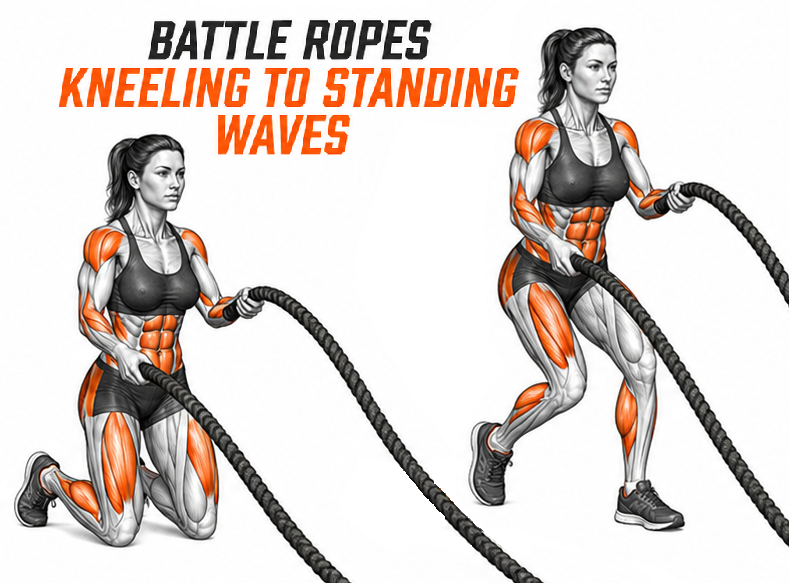
Battle Ropes Kneeling to Standing Waves
The shoulders keep the waves alive while you transition down to kneeling and back up, adding a leg and core challenge to the rope work.
Level: Intermediate
Primary: Shoulder
Secondary: Cardio Glutes Quads
Movement: Compound
Type: Anaerobic Intervals (HIIT / Bootcamp / Circuit) Functional Fitness (Obstacle & Hybrid)
Equipment: Battle Ropes
Target muscles
The deltoids carry the constant wave work while the forearms grip and the upper back stabilises, exactly as in a standing wave. The transition recruits the quads and glutes to lower under control to kneeling and stand back up, and the core works hard to keep the trunk stable and the waves uninterrupted through the level change. Adding the up-and-down movement raises the cardiovascular cost and challenges coordination, so the conditioning demand climbs alongside the shoulder endurance.
How to perform
Setup
Stand facing the anchor with a rope end in each hand and light tension on the line. Set a shoulder-width stance, soften the knees, and brace the trunk with the chest tall and the shoulders set down. Pad the floor behind you if it is hard, since you will be dropping to the knees. Begin alternating waves before you start the transition so the rhythm is locked in and your weight stays balanced through the feet.
Execution
Keeping the waves going the whole time, step or lower one knee to the floor, then the other, until you are kneeling tall — never letting the rope rhythm break. Reverse the sequence, planting one foot and then the other to stand back up, all while the waves continue. Move through the transition smoothly and keep the torso upright rather than folding forward. The skill is maintaining unbroken, even waves while the legs change levels, so prioritise rope continuity over speed of transition.
Common mistakes
- Letting the waves stop or shrink during the transition instead of keeping them constant.
- Dropping to the knees heavily rather than lowering under control.
- Folding the torso forward as you change levels, which strains the lower back.
- Rushing up and down so the movement becomes uncoordinated and the ropes go slack.
Progressions and regressions
Regress by holding steady waves in just one position, kneeling or standing, before adding the transition, or by lowering one knee at a time with a pause. Progress by speeding the up-and-down cycle, lengthening the interval, or switching to double waves through the change. Adding a half-kneeling pause, alternating which knee leads each rep, or finishing the stand with a small squat all raise the coordination and conditioning challenge.
Programming notes
Use it as conditioning or functional circuit work, 3-6 rounds of 30-45 seconds or a set number of full up-down cycles. The level changes make it more taxing than a plain wave, so it fits a metabolic block or a functional circuit well. Keep the transitions controlled and the waves honest throughout, and pad the knees if the floor is hard.