Treadmill High Knees
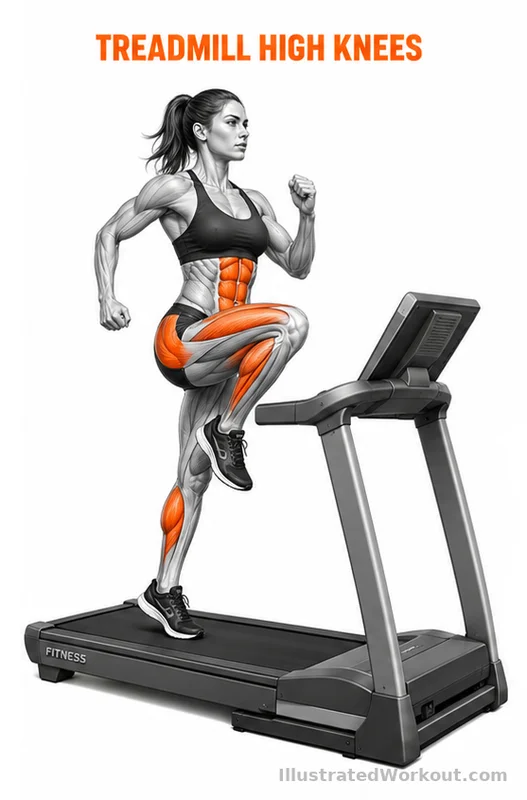
A run-in-place drill lifting the knees toward hip height at pace, spiking the heart rate while the hip flexors and abs power each lift.
Want a treadmill conditioning workout?
Our wizard builds one around your time, goal, and equipment in about two minutes. Free — no signup needed.
Make Me a Workout → Just did it? Track your setsA run-in-place drill lifting the knees toward hip height at pace, spiking the heart rate while the hip flexors and abs power each lift.
Level: Foundation
Primary: Cardio
Secondary: Abs Quads
Movement: Isolation
Type: Aerobic (Cardio) Anaerobic Intervals (HIIT / Bootcamp / Circuit)
Equipment: Treadmill
Target muscles
Driving the knees up toward hip height calls on the hip flexors and rectus abdominis to lift each leg fast, while the quads finish the knee drive. The calves and feet handle the quick, springy ground contacts and the glutes extend the support leg. Sustained at pace, the effort becomes strongly cardiovascular, with the core working to keep the torso tall between the fast knee lifts.
How to perform
Setup
Set a slow belt speed or run the drill nearly in place at the front of the deck, holding a rail lightly until the rhythm is set. Stand tall with the chest up, weight on the balls of the feet, and arms bent to ninety degrees in a running posture. Brace the trunk so the torso stays upright.
Execution
Drive the knees up alternately toward hip height in a fast marching-to-running rhythm, pumping the arms in time with the legs. Stay light on the balls of the feet with short, quick contacts, and keep the torso tall rather than leaning back to swing the knees up. Lift with the hip flexors and abs instead of hopping the whole body upward. Build the cadence gradually and breathe in rhythm. Keep the belt slow enough that you can maintain form and step off safely.
Common mistakes
- Leaning the torso back to fling the knees up instead of lifting them with the hip flexors and abs.
- Landing flat and heavy rather than staying springy on the balls of the feet.
- Dropping the knee height as fatigue sets in until the drill becomes a shuffle.
- Letting the arms go slack, which slows the cadence and blunts the heart-rate response.
Progressions and regressions
Regress to a marching high-knee at walking cadence with a hand on the rail, lifting one knee at a time. Progress by increasing cadence, extending the interval, or alternating bouts of high knees with butt kicks for a tougher block. Adding light forward travel down a manual belt raises the demand further.
Programming notes
Use it as a dynamic warm-up to fire the hip flexors and raise core temperature, twenty to thirty seconds, or as conditioning in thirty to forty-five second intervals inside a circuit. It is low-skill and joint-friendly, so it suits most trainees. Keep the belt speed conservative and the contacts light; back off if the hip flexors cramp from sustained fast lifting.