Treadmill Crawling
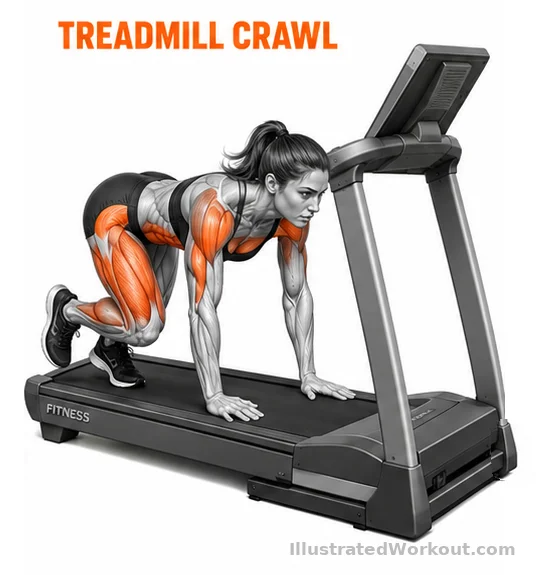
A bear-style hands-and-feet crawl marching a slowed belt, firing the shoulders, quads and deep core while the trunk resists twisting.
Want a treadmill full-body workout?
Our wizard builds one around your time, goal, and equipment in about two minutes. Free — no signup needed.
Make Me a Workout → Just did it? Track your setsA bear-style hands-and-feet crawl marching a slowed belt, firing the shoulders, quads and deep core while the trunk resists twisting.
Level: Intermediate
Primary: Full Body
Secondary: Quads Shoulder
Movement: Compound
Tags: Animal Movement Core Stability
Type: Functional Fitness (Obstacle & Hybrid) Primal Movments (Animal Flow-QMT Specifics)
Equipment: Treadmill
Target muscles
On hands and toes with the knees just off the floor, the shoulders and serratus press the body up while the quads and hip flexors drive the knees forward. The abs and obliques work hard as anti-rotation muscles, keeping the hips from swaying as opposite limbs move. The triceps, forearms and even the calves contribute, making this a demanding full-body pattern that loads the shoulders and core continuously.
How to perform
Setup
Drop the treadmill to its slowest manual setting or kill the motor so the belt responds only to your drive. Set the hands on the deck at the front, shoulder-width, with the knees bent and hovering an inch off the belt. Round the upper back slightly, brace the abs, and set the hips level with the shoulders.
Execution
Crawl forward moving the opposite hand and foot together, keeping the knees low and gliding rather than bobbing up and down. Push the belt back under you with each step, staying compact and controlled. Hold the hips low and quiet so the core does its anti-rotation job; the belt will expose any sway immediately. Take short, deliberate steps and breathe steadily. Keep the neck neutral with the gaze just ahead of the hands, and stop if the hands begin sliding faster than you can step.
Common mistakes
- Letting the hips pike up and rock side to side instead of holding them low and level over the belt.
- Reaching too far with each hand so the shoulders travel past the wrists and lose their stable base.
- Using a powered belt at too high a speed, which drags the hands and breaks the crawl rhythm.
- Holding the breath and tensing the neck rather than breathing steadily with a long spine.
Progressions and regressions
Regress to a stationary bear-crawl hold with the knees hovering, or crawl on the floor next to the machine to master the contralateral timing first. Progress by covering more distance, slowing the tempo for greater core time under tension, or pausing for a knee-hover hold between steps. Adding a light tap of hand to opposite shoulder ramps up the anti-rotation demand.
Programming notes
Slot it into animal-flow warm-ups, functional circuits, or core-focused finishers, using two to four bouts of twenty to forty seconds or a fixed crawl distance. It teaches contralateral coordination and reflexive core bracing that transfer to sport. Keep it slow and controlled, protect cranky wrists with fists or parallettes if needed, and always verify the belt is manual or barely moving before you begin.