Treadmill Crab Walk
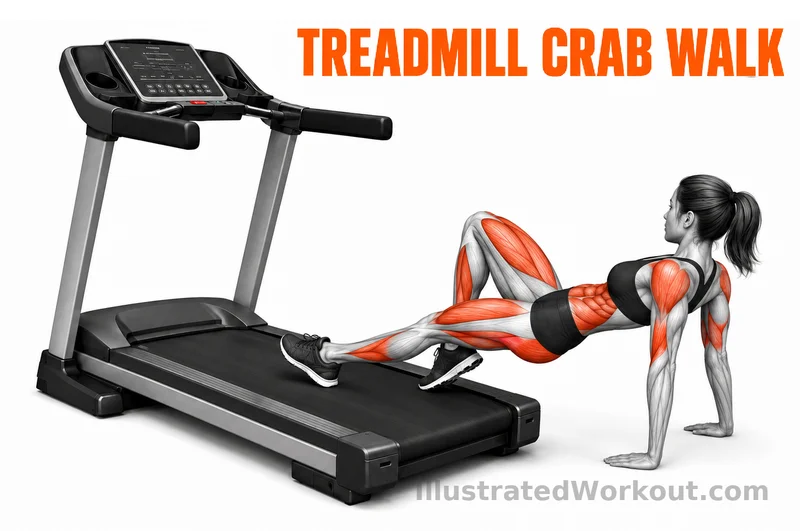
A reverse-facing floor crawl driven along a slowed belt, working the triceps, glutes and shoulders while the braced core keeps the hips lifted.
Want a treadmill full-body workout?
Our wizard builds one around your time, goal, and equipment in about two minutes. Free — no signup needed.
Make Me a Workout → Just did it? Track your setsA reverse-facing floor crawl driven along a slowed belt, working the triceps, glutes and shoulders while the braced core keeps the hips lifted.
Level: Intermediate
Primary: Full Body
Secondary: Abs Glutes Shoulder
Movement: Compound
Tags: Animal Movement Core Stability
Type: Functional Fitness (Obstacle & Hybrid) Primal Movments (Animal Flow-QMT Specifics)
Equipment: Treadmill
Target muscles
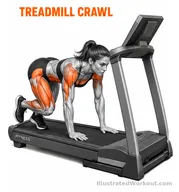
Facing the ceiling with the hips lifted, the triceps and posterior shoulders press the body up while the glutes and hamstrings hold the hips high against gravity. The abs and deep trunk muscles brace hard to stop the pelvis from sagging, and the quads assist as the legs drive the belt back. Because the shoulders sit behind the body carrying weight, the arms and upper back work overtime, making it a genuine full-body effort.
How to perform
Setup
Set the treadmill to its slowest manual speed or switch the motor off so the belt only moves when you push it. Sit facing away from the console, plant the hands behind you with fingers pointing back and the feet flat in front. Press the hips up so the torso and thighs form a tabletop, and brace the abs firmly.
Execution
Walk the belt underneath you by driving through the heels and pressing steadily through the arms, moving a hand and the opposite foot in a coordinated crab pattern. Keep the hips level and lifted the entire time so the glutes stay switched on and the low back stays protected. Move deliberately rather than fast, keeping the shoulders stacked over or behind the wrists so the joint stays supported. Breathe in a steady rhythm and stop the moment the hips start to drop toward the belt.
Common mistakes
- Letting the hips sag toward the belt, which dumps the load off the glutes and strains the low back.
- Setting a powered belt too fast, which yanks the feet forward and is genuinely unsafe in this position.
- Piking the hips up high and shuffling instead of holding a level tabletop and driving smoothly.
- Craning the neck back to look around instead of keeping it long with the gaze up.
Progressions and regressions
Regress to a stationary crab-bridge hold, or crab-walk on a firm floor beside the treadmill to learn the pattern before adding the moving belt. Progress by increasing the distance travelled, slowing the tempo to raise time under tension, or adding a hip-dip touch between steps. Reaching one arm across to the opposite foot adds a rotational challenge.
Programming notes
Program it as a functional-strength or core-stability station, two to four bouts of twenty to forty seconds or a set crawl distance. It fits animal-flow warm-ups, bootcamp circuits and shoulder-and-core conditioning blocks. Because of the shoulders-behind-the-body position, ease off if the wrists or shoulders are cranky, and always confirm the belt is slow or manual before starting.