Treadmill Balls of Feet
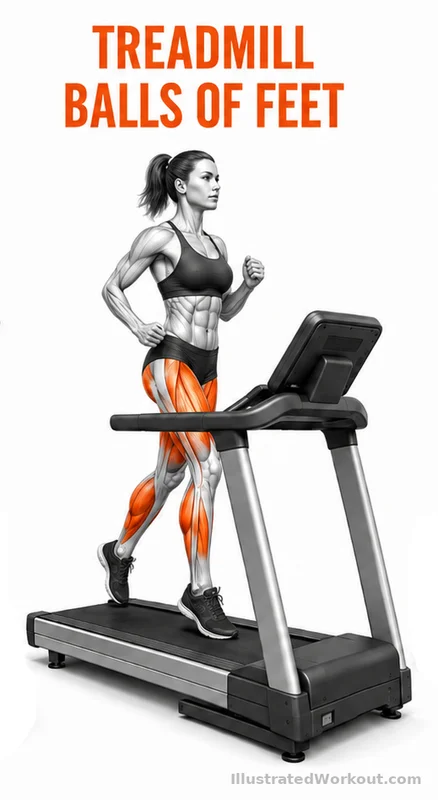
Running high on the balls of the feet keeps the heels off the belt, loading the calves through every stride while building springy ankle stiffness.
Want a treadmill leg workout?
Our wizard builds one around your time, goal, and equipment in about two minutes. Free — no signup needed.
Make Me a Workout → Just did it? Track your setsRunning high on the balls of the feet keeps the heels off the belt, loading the calves through every stride while building springy ankle stiffness.
Level: Foundation
Primary: Calves
Secondary: Cardio
Movement: Isolation
Type: Aerobic (Cardio)
Equipment: Treadmill
Target muscles
The gastrocnemius and soleus carry the effort here, holding the heels clear of the belt and springing the body off each contact. The tibialis and small foot muscles stabilise the arch, the quads and hip flexors cycle the legs through, and keeping the whole body tall on the forefoot holds the calves under near-constant tension while the heart rate climbs. It is a targeted calf drill dressed up as light cardio.
How to perform
Setup
Straddle the belt or hold the side rails as you set a slow, walkable speed. Step on and rise onto the balls of both feet with the heels hovering just above the belt. Stack the ribs over the hips, soften the knees, and look forward rather than down at your feet so the spine stays long.
Execution
Jog forward staying high on the forefoot so the heels never touch down, letting the calves absorb and return each contact. Keep ground contacts short and quiet, pushing the belt back with the ball of the foot. Hold the torso tall and drive the arms in a compact running rhythm. Breathe steadily and keep the cadence quick; the moment the heels start slapping down, ease the speed. Start with a hand near the rail until the balance on the forefoot feels secure.
Common mistakes
- Dropping the heels to the belt between strides, which cancels the constant calf loading the drill is built on.
- Setting the speed too high before the forefoot balance is solid, forcing a heel-heavy, unsafe stride.
- Looking down at the feet, which rounds the back and shifts weight off the balls of the feet.
- Letting the ankles roll inward instead of keeping pressure through the big-toe side of the forefoot.
Progressions and regressions
Regress by marching tall on the balls of the feet at walking pace with a hand on the rail, or by doing short calf-raise holds off the belt first. Progress by lifting the speed into a light forefoot jog, extending the time under tension, or adding a gentle incline to deepen the calf stretch and load at each contact.
Programming notes
Use it as calf conditioning and ankle-stiffness work, thirty to sixty second bouts for three to five rounds, or as a warm-up primer before sprint or plyometric work. It builds the springy forefoot contact that faster running relies on. Keep speeds modest, and skip it if the Achilles or calf is tender, since continuous forefoot loading concentrates stress on those tissues.