Sled Push
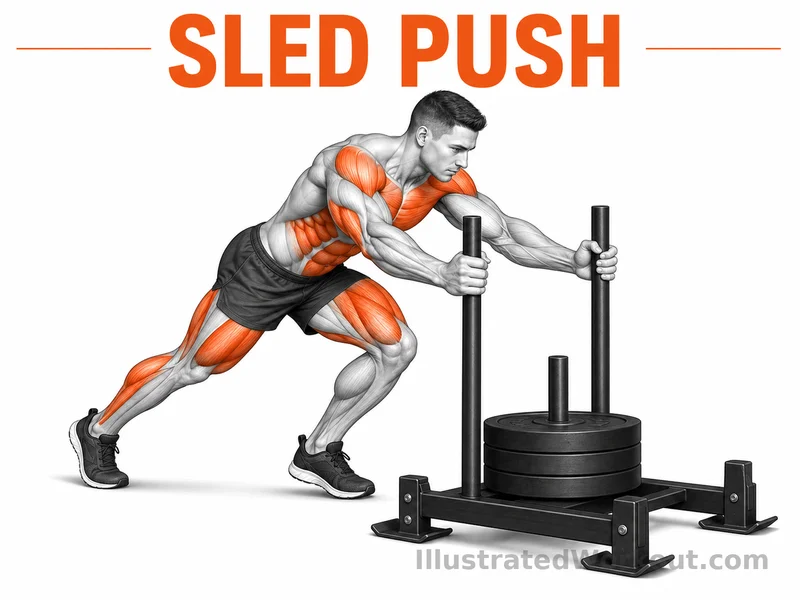
Driving a loaded prowler forward with a hard forward lean turns the legs, hips and shoulders into one whole-body engine.
Want a sled full-body workout?
Our wizard builds one around your time, goal, and equipment in about two minutes. Free — no signup needed.
Make Me a Workout → Just did it? Track your setsDriving a loaded prowler forward with a hard forward lean turns the legs, hips and shoulders into one whole-body engine.
Level: Intermediate
Primary: Full Body
Secondary: Calves Glutes Quads Shoulder
Movement: Compound
Tags: Loaded Carry Push
Type: Anaerobic Intervals (HIIT / Bootcamp / Circuit) Functional Fitness (Obstacle & Hybrid) Strength (Weight Lifting)
Equipment: Sled
Target muscles
Every stride is a leg press against the ground: the quads extend the knees, the glutes and hamstrings drive the hips forward, and the calves finish each push off the toes. With the arms locked out on the poles the shoulders, triceps and chest hold the pushing frame rigid so force travels from the legs into the sled. The core braces hard to keep the body a straight lever from ankle to hand, making this a genuine whole-body effort that is almost entirely concentric.
How to perform
Setup
Grip the prowler's high or low poles and step back until the arms are straight and the body forms a long line leaning into the sled. Set the feet behind the hips, rise onto the balls of the feet, and brace the abs. Pack the shoulders and keep a neutral spine so the lean is supported rather than collapsed.
Execution
Drive one foot hard into the ground and extend the leg to push the sled forward, then immediately step and drive the other leg, keeping the arms locked throughout. Maintain the forward lean so your body weight and leg power stay behind the load. Aim for continuous turnover — short, powerful, choppy steps that never let the sled stall. Keep the hips low and the torso in a straight line from the shoulders through the driving leg. Breathe in bursts and hold the lean steady as the legs burn toward the end of the length.
Common mistakes
- Standing too upright so the lean is lost and the sled feels immovable off the legs.
- Bending the arms, which lets the chest drop toward the sled and wastes the leg drive.
- Taking long, slow steps that stall the sled rather than fast, punchy turnover.
- Loading so heavy that the stride collapses and the hips can no longer extend on each push.
Progressions and regressions
Regress by lightening the load or pushing the high poles, which makes the lean easier to hold. A shorter lane lets beginners keep good turnover before extending it. Progress by adding plates, gripping the low poles for a steeper drive angle, or pushing for maximal speed as a sprint. A heavy, near-maximal push becomes pure strength work, while a lighter, faster push is brutal conditioning.
Programming notes
Use it for power-endurance and conditioning or as leg-strength finisher work, six to ten lengths of fifteen to thirty metres or heavy twenty-metre pushes with full rest. Heavy loads build lower-body strength and drive; lighter loads pushed fast spike the heart rate hard. Because it is concentric-dominant it delivers this without heavy soreness, so it suits in-season athletes. Keep the lean and turnover crisp, and end the effort when the stride shortens and the sled stalls.