Sled Pull
Hauling a loaded sled while walking backward lights up the whole posterior chain, quads and upper back in one continuous, low-impact effort.
Want a sled full-body workout?
Our wizard builds one around your time, goal, and equipment in about two minutes. Free — no signup needed.
Make Me a Workout → Just did it? Track your setsHauling a loaded sled while walking backward lights up the whole posterior chain, quads and upper back in one continuous, low-impact effort.
Level: Intermediate
Primary: Full Body
Secondary: Back - Upper Glutes Hamstrings Quads
Movement: Compound
Tags: Loaded Carry Pull
Type: Anaerobic Intervals (HIIT / Bootcamp / Circuit) Functional Fitness (Obstacle & Hybrid) Strength (Weight Lifting)
Equipment: Sled
Target muscles
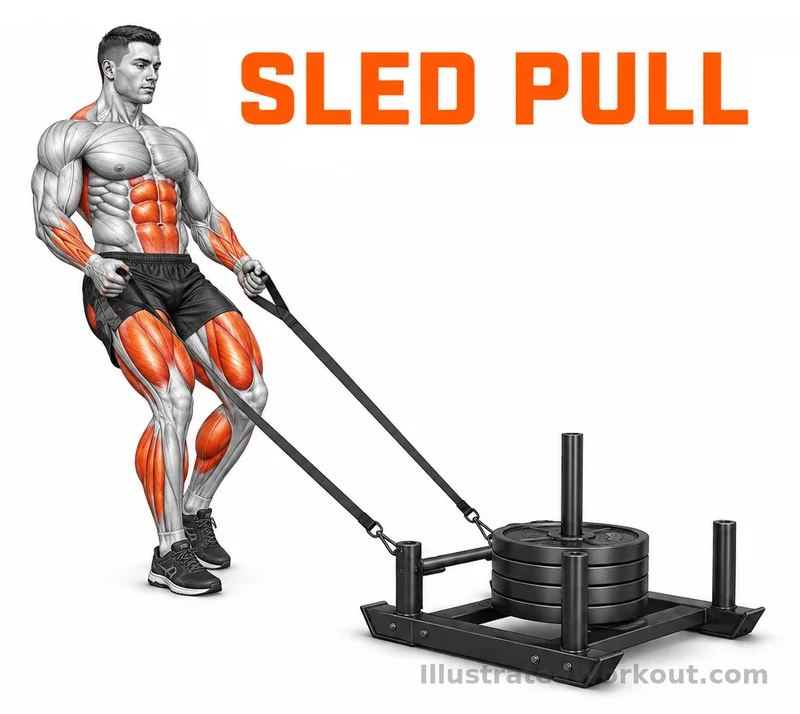
Walking backward against the sled turns it into a whole-body pull. The quads take a heavy share as they extend the knee on each backward step, while the glutes and hamstrings drive the hips and stabilise the stride. Through a strap or handles the lats, mid-back and rear deltoids pull the load, and the biceps and forearms grip and flex to keep tension on the line. The trunk braces hard to transfer force between the pulling arms and the driving legs, and the movement stays concentric so there is little eccentric stress.
How to perform
Setup
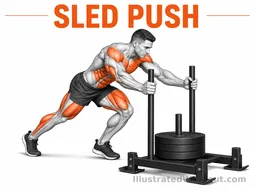
Face the sled and take a strap or the handles in both hands, arms extended and the line taut. Sit the hips back into a slight squat, chest up and shoulders packed down. Set the feet hip-width, brace the abs, and load the weight onto the mid-foot ready to step back.
Execution
Walk backward in controlled steps, pulling the sled toward you as you go. Drive each foot back and extend the leg while the arms keep steady tension on the strap, letting the upper back help haul the load. Keep the hips low and the torso stable so the legs and back share the work rather than the lower back rounding. Maintain continuous turnover so the sled tracks smoothly behind your steps. Glance over a shoulder to steer, keep the chest tall, and breathe in rhythm with the stride across the length.
Common mistakes
- Standing tall and yanking with the arms only, which wastes the powerful leg drive that should move the load.
- Letting the hips rise so the quads disengage and the lower back takes the strain.
- Taking choppy, uneven steps that make the sled stall and lurch instead of tracking smoothly.
- Rounding the shoulders forward rather than packing them down to protect the pull.
Progressions and regressions
Regress by lightening the sled and shortening the lane so the backward stride stays controlled. New lifters can walk slowly to learn the rhythm before adding load or speed. Progress by piling on plates, extending the distance, or pulling for a hard timed effort. A low-handle backward drag biases the quads further, while a hand-over-hand rope pull isolates the upper back and grip.
Programming notes
Program it as full-body conditioning or leg and back accessory work, six to ten lengths of twenty to thirty metres or thirty-to-forty-second efforts with walk-back rest. The backward drag is quad-dominant and joint-friendly, making it a favourite for knee rehab and in-season conditioning where soreness must stay low. Keep the hips down and the steps even; call the set when the stride shortens or the pace stalls.