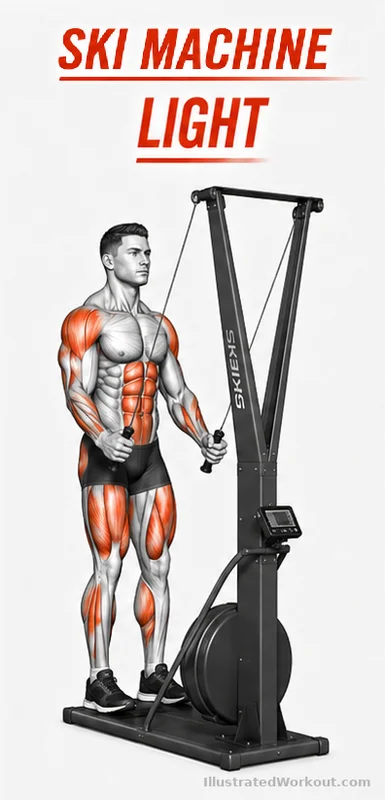
Ski Machine Light
Gentle double-pole pulls on the ski erg that groove the lats, triceps and core while keeping the effort easy and conversational.
Want a ski machine conditioning workout?
Our wizard builds one around your time, goal, and equipment in about two minutes. Free — no signup needed.
Make Me a Workout → Just did it? Track your setsGentle double-pole pulls on the ski erg that groove the lats, triceps and core while keeping the effort easy and conversational.
Level: Beginner
Primary: Cardio
Secondary: Abs Back - Upper Triceps
Movement: Compound
Type: Aerobic (Cardio) Light Activity
Equipment: Ski Machine
Target muscles
The double-pole action of the ski erg is driven by the lats and upper back pulling the handles down, the triceps extending the elbows to finish the stroke, and the abdominals crunching the torso forward to add power through the trunk. The shoulders and chest assist the pull, and the legs give a soft bend and drive to link the body to the ground. Kept light, none of it is heavily loaded; the aim is smooth technique and easy circulation.
How to perform
Setup
Stand a comfortable arm's length from the machine, feet hip-width, and reach up to grip the handles overhead with straight arms. Set a soft bend in the knees and hips, and keep the spine long with the core lightly braced. Choose a low damper so each pull feels light, and plan to keep the rhythm slow and relaxed.
Execution
Pull the handles down together, hinging the torso forward and crunching the abs as the arms sweep past the hips, then let the handles rise smoothly as you stand tall to reset for the next stroke. Keep the effort down at a three or four out of ten, an easy pace where breathing stays slow and conversation is effortless. Move fluidly, using the whole body in a gentle wave from the trunk through the arms rather than yanking with the shoulders alone. Breathe naturally and evenly, and focus on grooving a clean, connected double-pole for the full duration.
Common mistakes
- Pulling with the arms only and ignoring the trunk crunch, which disconnects the stroke and tires the shoulders.
- Keeping the legs and hips rigid so the body cannot hinge into each pull.
- Rounding the lower back sharply at the bottom instead of hinging with a long, braced spine.
- Rushing the rhythm until the easy session quietly becomes a moderate one.
Progressions and regressions
Regress by slowing the stroke rate, shortening the piece, or breaking the pull into slow segments to learn the hinge-and-crunch timing. Progress by lifting the pace and effort toward a Ski Machine Moderate rhythm, adding a little damper, or extending the duration. Once the pattern is smooth, interval bursts build toward Ski Machine Sprint conditioning.
Programming notes
Use it as an upper-body-friendly warm-up, a cool-down, or easy active recovery for five to twenty minutes, and as the ideal place for a beginner to learn the double-pole without fatigue wrecking technique. It moves the back, arms and core with no impact, complementing lower-body training nicely. Keep it genuinely light; its job is clean technique and gentle blood flow, so leave the hard pulling to the moderate and sprint versions.