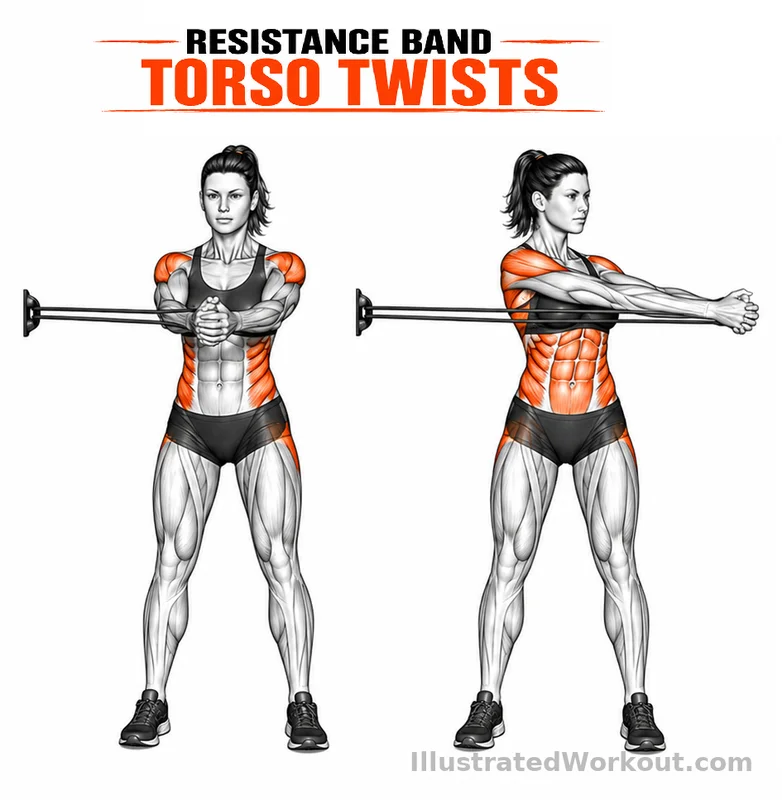
Resistance Band Torso Twist
A standing anti-band rotation that turns the trunk against an anchored band, training the obliques to produce and control twisting force.
Want a resistance band core workout?
Our wizard builds one around your time, goal, and equipment in about two minutes. Free — no signup needed.
Make Me a Workout → Just did it? Track your setsA standing anti-band rotation that turns the trunk against an anchored band, training the obliques to produce and control twisting force.
Level: Beginner
Primary: Abs
Movement: Isolation
Tags: Rotational
Type: Functional Fitness (Obstacle & Hybrid) Strength (Weight Lifting)
Equipment: Resistance Band
Target muscles
The internal and external obliques do the rotating, pulling the ribcage around against the band while the rectus abdominis and deep transverse abdominis brace the spine. The hips and glutes stabilise the base so the rotation comes from the trunk rather than the legs. The band's pull grows through the twist, so the obliques are challenged most at the end of the turn, where rotational strength is built.
How to perform
Setup
Anchor the band at roughly chest height and stand side-on to it, feet shoulder-width. Grip the handle with both hands and extend the arms out in front of your sternum, stepping away until there is tension. Square the hips forward, soften the knees and brace the abs as if bracing for a nudge.
Execution
Keeping the arms straight and the hips facing forward, rotate the trunk away from the anchor by turning through the ribcage and obliques. Move at a controlled pace and only as far as you can turn without the hips swinging around. Pause where the band is tightest, then return slowly, resisting the snap-back so the obliques control the way in as well as the way out. Keep the chest tall and the arms locked so the twist stays in the torso. Exhale as you rotate away, inhale as you come back.
Common mistakes
- Turning the hips and feet with the arms so the legs do the work instead of the obliques.
- Bending the elbows and pushing the band, which turns the twist into a press.
- Letting the band whip the torso back fast rather than controlling the return.
- Over-rotating into the low back instead of stopping where the abs can own the movement.
Progressions and regressions
Regress by standing closer to the anchor for less tension or shortening the range of the twist. Progress with a heavier band, standing farther away, adding a pause at full rotation, or moving to a half-kneeling stance that removes the legs and forces the core to work harder. A cable or medicine-ball wood chop carries the same rotational pattern with a diagonal path.
Programming notes
Program it for ten to fifteen reps per side over two or three sets as core work on almost any day, or inside a functional circuit. It trains rotary strength that transfers to throwing, swinging and change-of-direction sports. Keep the reps smooth and the load moderate — rotational core work rewards control, and heaving a heavy band tends to dump force into the lumbar spine rather than the obliques.