Resistance Band Clam Shells
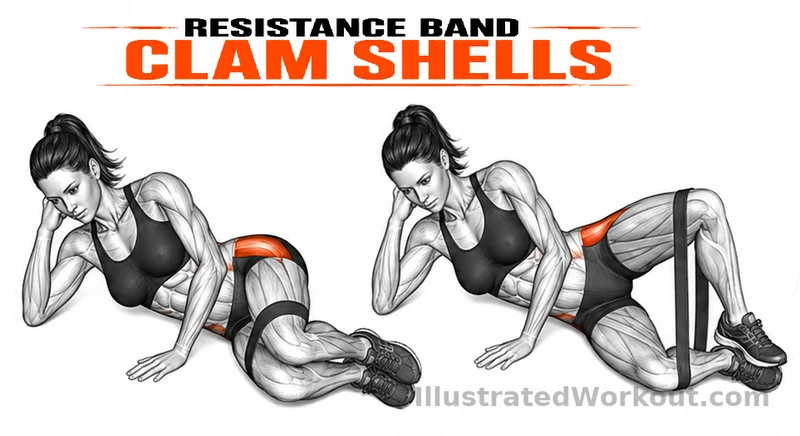
Side-lying hip abduction that rotates the top knee open against a looped band, isolating the gluteus medius for hip stability.
Want a resistance band leg workout?
Our wizard builds one around your time, goal, and equipment in about two minutes. Free — no signup needed.
Make Me a Workout → Just did it? Track your setsSide-lying hip abduction that rotates the top knee open against a looped band, isolating the gluteus medius for hip stability.
Level: Beginner
Primary: Abductors
Secondary: Glutes
Movement: Isolation
Type: Strength (Weight Lifting)
Equipment: Resistance Band
Target muscles
Hip abduction and external rotation drive this movement, so the gluteus medius and the deeper gluteus minimus open the top knee. The gluteus maximus assists at the top of the range, and the deep hip rotators help control the movement. Because the loop's resistance increases as the knees separate, the hip abductors face their toughest pull at the fully opened position, which is exactly where stability is needed most.
How to perform
Setup
Loop a mini band just above the knees and lie on your side with the hips and knees bent to roughly ninety degrees, stacking the top hip over the bottom. Rest your head on the lower arm and place the top hand on the floor for balance. Draw the abs in gently so the pelvis stays still.
Execution
Keeping the feet touching and the pelvis square, rotate the top knee upward and open against the band as far as the hip allows without the pelvis rolling back. Feel the outer glute, not the low back, produce the movement. Pause at the top where the band is tightest, then lower the knee slowly against its snap-back over two seconds. Keep the motion isolated to the hip; do not let the torso rock. Breathe out as the knee opens and in as it closes.
Common mistakes
- Rolling the top hip and pelvis backward to open the knee wider, which cheats the glute out of the work.
- Letting the feet drift apart so the movement loses its clam shape.
- Snapping the knee shut on the band's rebound instead of lowering under control.
- Using a band so heavy that the low back and hip flexors take over from the glute medius.
Progressions and regressions
Regress by removing the band and opening the knee against gravity alone, or using a lighter loop. Progress by choosing a heavier band, adding a two-second hold at the top, or raising the bottom foot off the floor to increase the demand. A standing banded abduction variation carries the same pattern into a weight-bearing position.
Programming notes
Use it as glute activation before squats and deadlifts, fifteen to twenty-five reps per side, or as rehab and accessory volume for runners and anyone with hip or knee tracking issues. It is low-skill and joint-friendly, so it suits beginners and warm-ups well. It is an isolation drill, not a strength lift, so keep the reps higher and chase a clean burn in the outer glute rather than heavy resistance.