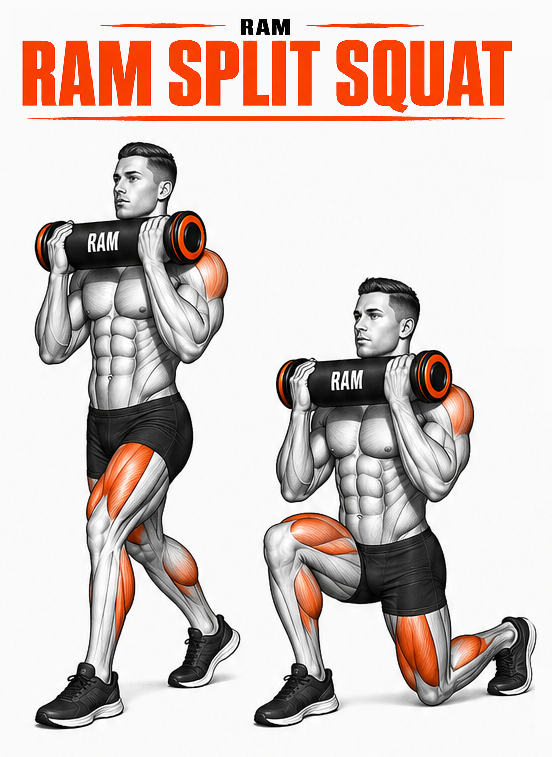
RAM Split Squat
A stationary split squat holding the RAM at the chest, building single-leg strength, balance and mobility.
Level: Foundation
Primary: Quads
Secondary: Glutes Hamstrings
Movement: Compound
Tags: Lunge Unilateral
Type: Functional Fitness (Obstacle & Hybrid) Strength (Weight Lifting)
Equipment: RAM
Target muscles
The lead-leg quads and glutes do the bulk of the work, with the hamstrings and adductors assisting and the rear leg helping to stabilise. Holding the RAM at the chest loads the movement and keeps the torso upright, adding a core demand. The static stance lets you focus on depth, control and ironing out left-right differences.
How to perform
Setup
Hold the RAM at the chest by the handles and set up in a split stance — front foot flat, rear foot back on the ball of the foot, feet roughly hip-width apart side to side for stability. Stand tall and brace.
Execution
Lower straight down by bending both knees until the front thigh is about parallel and the rear knee hovers just above the floor. Keep the front shin fairly vertical and the knee tracking over the foot, with the torso upright and the RAM stable. Drive through the front foot to return to the start. Complete the reps on one leg, then switch.
Common mistakes
- Letting the front knee cave inward or drift well past the toes.
- Leaning the torso forward and losing the upright RAM position.
- Pushing off the rear foot instead of driving through the lead leg.
- Taking too narrow a stance, which hurts balance.
Progressions and regressions
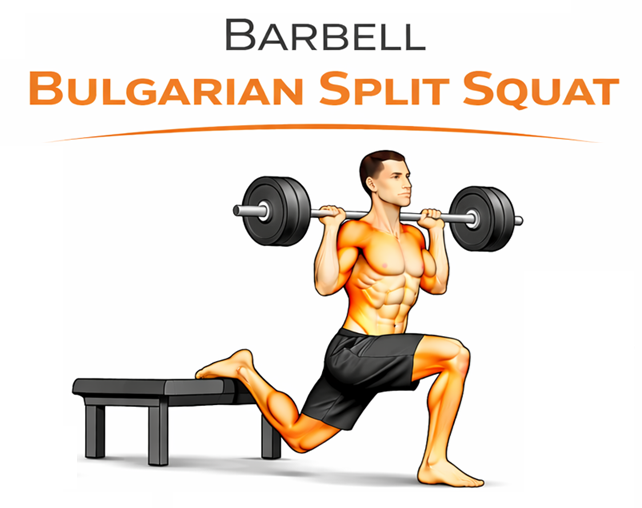
Regress to a bodyweight split squat to build balance and the pattern. Progress by adding load, slowing the descent, pausing at the bottom, or elevating the rear foot for a Bulgarian split squat. It's a key stepping stone to harder single-leg work.
Programming notes
Program it as a foundational single-leg builder, 3-4 sets of 8-12 per leg. It develops unilateral strength, balance and hip mobility and exposes side-to-side weaknesses. Use it as a main lower-body movement or accessory, keeping the reps even between legs.